Showing posts with label Ranger. Show all posts

November 28, 2013

Managing the Low Points "Come on Joe, Let Yourself Have a Good Day" (Thriving)


Fa thump, fa thump, fa thump was the sound of my forefoot and mid sole strikes echoed by the rhythm of my breathing ha whoo, ha whoo, ha whoo and finished with the feeling of my heart beating kwa fump, kwa fump, kwa fump. It is hard for the rhythm of contact with the land, lungs and heart beat to synchronize so effortlessly, but that was how I felt as I powered through the thirtieth mile of the JFK 50 miler. That is the point when I know I can finish, but something different occurred this year. I was having an amazing day with nothing noteworthy to complain about. My legs hurt, but I had no heat cramps, I was tired, but extremely motivated, my brain was so taxed that I could not remember the names of the people around me, but somehow I was managing the math for all my mileage splits in my head. Everything was as it should have been for the strongest run in my life.

Usually this point is a reckoning and the finish my sole motivator, but this year I went into beast mode. I grunted in a primal desire to push forward. I was right where I wanted to be, still very tired, but from worthy effort and I repeated a mantra that had gotten me to mile thirty so strong physically and mentally. "Let yourself have a good day." Sometimes it is hard for me to have positive outlook. It is hard to believe that I can have good days. Sometimes in races like this my worry over an unmanageable low point will sap my energy, slow my pace down, and make something I love to do burdensome. People tried to pull me out of my race though.

"If your were in track club you would definitely run intervals and you could run sub 9 hour pace... I usually run that pace."

I am always annoyed with people who tell you they are having a bad day when you pass them. I could have got in my own head, but I waited for a rugged downhill, pulled away and said:

"Well, I run trails, mountains and stairs because that helps with me PTSD. My biggest issue is preventing panic attacks on runs so I focus on that. I seem to be doing great today, and I am just happy that all the causes of my panic attacks left me with my life, arms and legs. I am lucky to have days like today." He was apologetic, but I was too focused on the trail to acknowledge it. I did enjoy nothing-ing his attempt to correct his previously callous statement.

Most of the time I think it is in poor taste to over share these sorts of personal details with some random person on the trail, but in this case I was pissed off. However, like my injury at Bradbury Mountain in August I had earned a great day through all my hard work. Just because that guy ran harder last year didn't give him a pass on this year's lower level of training. I thanked Chick Hill again for all the rugged 7 minute mile paced rocky downhills that made this separation so easy and a conversation that could have been unsettling gave me a lot of confidence. It was a real battle this year to shave 55 minutes off of last year's finish. It took so much focus and discipline to run the first leg of the Appalachian Trail (AT) in a way that maxed my ability to climb with the fact that an elevated heart and the thick fall air were common triggers for me.

I ran on the razor's edge between hard effort and the prevention of a panic attack. I could do this because I trained myself on the terrain that most reminded me of combat and the explosion that gave me mTBI that inevitably made me a civilian. I wasn't going so far as criticizing someone's performance, but I had worked so hard and through real adversity. I wasn't going to have some track club split counter tell me how to train and run my race. On my second ultra I has used that style of training plan, but it landed me in an Intensive Care Unit for three days, so nothing was taking me off my plan.

PTSD and panic attacks were becoming a bit of an advantage. Running your best race without burning yourself out is a similarly difficult balancing act. A life that revolves around managing my anxiety was actually making me better on race day. But it was more than that.

I seemed to be gliding along effortlessly on the first section of the AT and the pace was not difficult until the late forties. I continued to run effortlessly on the first half of the C&O Canal. My deep longing to transcend and merge into the place I live in Maine had made my greatest strength running on rough and rocky trails. My feet slammed into rocks several times at JFK, but my balance kept me on my feet. On the single track trail my movements were light and I passed people with ease. The whole year I needed those rough trails because they were the only place I could stay in the moment. People kept complaining and I held my tongue until the last section of the AT.

"I love this shit so much... I am so happy to be here."

This made me look a like sadist, but it was true and this attitude was helping set the conditions for a great day. It had been hard and my biggest problem was consuming enough calories to keep going strong. I would eat PowerBar apple sauce and get sick for a few minutes while my digestion was competing with my quadriceps for energy. This would be worth it when the more slowly released applesauce carbohydrates paid dividends late in the race.
28.4 miles in at Antietam Aqueduct

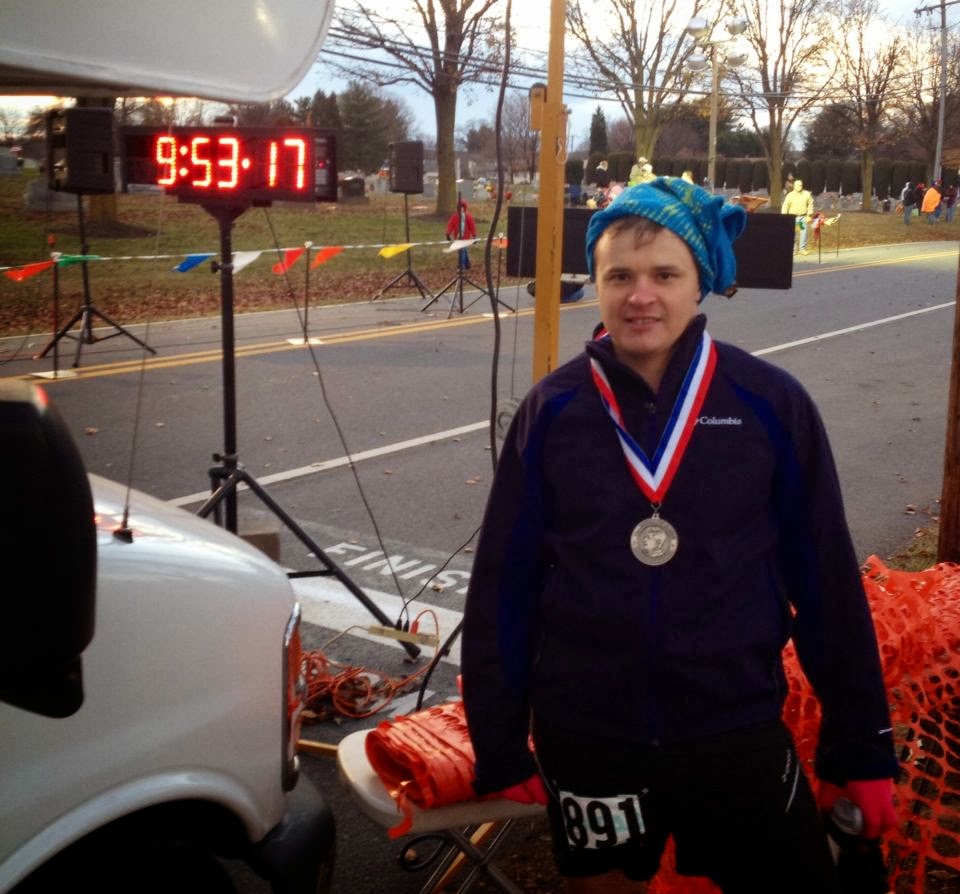
I was running my race plan perfectly. Get off the AT (15.5)  a little behind on pace and make it to Antietam Aqueduct on pace. I came of the AT at 12:49 pace and by Antietam I was at 11:49 splits, 14 seconds under 12 minute mile 10 hour pace. I gained about 5 minutes and I was so pumped. I recognized my pace earlier in the day, but I would wait till the last twenty miles to really grind at max effort. I can't describe the joy that comes when you do something as hard as run fifty miles in under 10 hours, and how amazing it feels to still have the fortitude to push harder in the last twenty miles. I invite anyone who thinks PTSD is a syndrome of the weak to line up with me next year and call me weak on the back twenty. At this point going that hard simply maintained my pace at 11:49. I was outside of myself, though the last 8 miles of road and high winds was miserable. I was tired, cold and on cloud nine. I kept a run down hill and straightaways, and walked uphill until I reached the last mile and a half. I must have clocked a 10 minute last mile because the finish line came quickly. I looked at the clock and it was 9:50(:32).


My wife was waiting for me and we were so excited. I let out a guttural yell, as if I was some medieval knight after vanquishing all my foes. I waited for, one of my living heroes and founder of Team Red, White and Blue, Mike Ervin to cross and as I cheered his equally amazing accomplishment. I never thought I would ever be able to stay in front of such amazing runners and leaders on veterans issues, it is still hard to believe that the day was not something I imagined.


http://teamrwb.org/

When life is miserable it is so much easier for me get stuck, but it is often what I do in the low points that sets the conditions for when I feel stronger. Its hard to run my race, suck down my applesauce and just let my legs keep going. Having PTSD feels like running on a gnarly, rocky and mountainous trail when everyone around you is on a smooth surface. Yet when I am on rocky trails I am in my element, and everything feels easier when I recognize how much harder life is for me. I need that perspective. At the JFK 50 Miler most the people around me left the AT demoralized while I left fired up, and easily made up my pace before my toughest push. I had time in the bank and chipped away a little more time in the last ten miles. PTSD keeps me in the doldrums a lot more than others and I often have to say things like, "just manage this low point Joe." Sometimes when I am in the toughest place on my path and its important to let those momentary set backs be momentary setbacks. Sometimes I struggle because the path is rocky, but when I manage my low points I sometimes find myself at Antietam Aqueduct with time in the bank, feeling amazing and surging forward because I did everything I could when the path was harder and everything was a lot more difficult. The contextually accurate positive self talk that guided me to an amazing day was just a representation of a coping mechanism that I have developed over months of practice. Managing PTSD is extremely difficult but it has taught me how to thrive in some of the most challenging of circumstances.

*Ultra Runner Geoff Roess is known for focusing on the low points on 100 mile races. It keeps me going every time I have a rough day.

August 23, 2013

(Thriving) Chick Hill

The Peaked Mountain and Little Peaked Mountain faces.

On a hot, but manageable August Sunday I found myself in Bradbury Mountain State Park running the toughest race of the year. The course's 1450 ft elevation gain and equal loss in only 9 miles makes it one of the most challenging in Maine without factoring all of the roots, rocks, and New England rock-wall obstacles you traverse to get to the finish. Ian Parlin is a sadist in the way that any good trail race director should be. He decided to cut out some downhill switchbacks to add about 400 more feet of gain and let us all know that at the starting line. That's why I run his races. So while getting to the boundary road with the addition of a strong climb I was excited about my pace without any panic attacks. After two days of rain  the course was wet and slippery, and I was still in a large crowd of people. As we started the first real climb (on the old course that is) my left foot landed on a rock was deceivingly wet and slippery. My left leg slipped, and from the bruising it appeared to have slammed into another rock or stump: a fact I was oblivious of at the time. What I was intimately aware of was the movement of my leg.

I have broken my ankle before, and I have never felt my leg move like it did at Bradbury. The ankle rolled so extremely that my knee snapped by the strain. I was instantly sickened in the way that you feel when ice breaks underneath you. "Fuck! Its time for six months of rehab." My brother-in-law was behind me and he later said that he thought I broke my leg. For a few seconds I knew that I broke my leg. The pain and nauseous feeling put me into a walk before my mind even fully reacted. I needed to walk as far as I could with the adrenaline I had because I was in the most remote place on the course (another runner passed out nearby and it took hours to get him off the course). "How was I walking though, my leg was broken right? It had to be." I walked up the hill. It hurt but my leg was working. "How was it working?" Sick and crying from the shock and the pain I started to run. I didn't know how I still could, but I'd worked too hard to run my best time. I deserved this and it might be my last run of the year, and I knew that, for some reason, my body takes three to five hours to swell up. Let's go! (Oh By the way Let's Go is the modo of my of my Airborne Infantry Regiment. Glider up son!)

The view from Little Peaked Mountain.
Chick Hill is not actually the title of the mountain that I have been climbing a lot lately, but it is what here everyone calls Peaked Mountain, which is situated near Chick Hill. I like that about Peaked Mountain. A lot of people climb it, but few really know its actual name. Even fewer truly appreciate it. Most of its trails are overgrown, its rocky road up to the cell phone tower is the only thing that is, albeit reasonably, well maintained. Its older, perhaps better, ridge-line trail has been absorbed into the forest. The fire break/road like surfaces are as technically difficult as any trail in the area. This would be where I would reconnect to my strongest mentality. The drive to Clifton Maine has become an obsession of mine lately. The whole week I am be excited about my sole foray to the mountain. I read maps, look at Google imagery to try and find new trails to run. I was working out, exploring and fusing with the place.

Birds eye view of Acadia National Park.
Peaked Mountain felt right, it was poorly managed, in places grossly clear cut, in others the forest had claimed the trail, and it was small and underrated. It felt like me, and I was building a relationship with a place. Not the tired and common unrealistic anthropomorphizing of a space, rather I was falling in love with its flaws as well as its charms. I'd come home covered in its tall unchecked grass, at times bleeding with little bits of mountain inside my knee and palms. Weeks later I would vacuum little bits of mountain from under the door mat for almost 10 minutes. I've bled and swet into the place and carried a little of it home with me with every trip. Too many people try to shape the land, or possess it, but few are shaped by it and let themselves be possessed by the space they live in. Even fewer would feel that way about a place with a man made road, a large cell phone tower, and beer bottles strewn about at the summit. Not me, I loved the place because that felt more like me. I could see Acadia to the south and the larger peaks to the west. Running goals that this place would help me meet, but I was deeply attached to the imperfections of the space. This was life and space that defied narrative: imperfectly appropriate. It was so much more like myself, in its beauty, its unkept and unfinished nature, yet at its summit was one of the most beautiful scenes in vacationland (Maine). Peaked Mountain had recharged me in ways that I haven't felt since I went to war.

Check the wince. Image Credit Maine Running Photos.
Bradbury was decidedly frustrating because of the sprained ankle, but I'd been here before. I'd sprained my ankle at my first 100 mile attempt and I went 29 miles on it before deciding it wasn't worth it to risk worse injury (my main effort that year was JFK and I wanted to get to the line uninjured). I'd sprained my ankle early on Bradbury's 12 mile Bruiser and finished. In Ranger school I had the worst sprain of my life on the march to Darby and made it through the whole phase (I recycled because I was too weak with that ankle). My wife says,"if Joe's gonna sprain his ankle its gonna be in the first two miles and he's gonna finish;" she just gets me. I was frustrated because I was doing so well and I thought that I wasn't going to have an improved time.

Bloodied compression socks. TRWB
No, I was ready for this and I could still do it! I'd spent too many days on Peaked Mountain and I'd earned an excellent performance. That was different, for the first time in years I felt like I owed myself a victory. I was worth it, and I might have even owed it to Peaked for all the time I spent on it. More pragmatically the way I'd run Peaked Mountain prepared me. On my toughest 8 miler, I started by climbing the grade 8, 1.5 mile, 800 ft gain, category 3 climb up to the summit. After catching a toe I scraped up my knee and it was initially bleeding pretty bad. I pulled my compression socks over it to stop the bleeding and ran down the mountain. Halfway down the mountain I checked my leg and the bleeding had stopped. Let's go! I wanted to add some to speed to my total pace so I turned unto a firebreak that led to the actual Chick Hill. I took a left hand turn down what, I guess, was a logging road that wasn't on the map and didn't make it to Chick Hill. The initial climb made my calves all but useless so I had to rely on my quadriceps to ensure that I could hike up the summit and still be at a good ultra pace (12 minute miles).

I was busting my butt (literally) and quads to maintain nine minute miles so that my ending split would still be at running pace with all the hiking involved. I pushed up Little Peaked Mountain's summit at a good hike and ran up Peaked again. My pace on that 1900 ft total climb was faster than last years Breaker. I began to realize that I needed both the climbing calves and quads to manage the terrain at the Chick area so I started adding faster flatter running with my dog Darby and my mountain days got better and better. I felt awesome, and fulfilled.

More importantly I'd hiked so much at racing pace. Just minutes after my sprain came the south ridge of Bradbury Mountain. I was not feeling up to running that kind of grade just yet so I leaned forward put my hands on my knees and hiked. To my surprise my walking wasn't only keeping pace, but gaining on most of the runners around me. The descents were more difficult. I had my ankle fully extended when it twisted so it seemed to only really be acting up on steep downhill terrain. The down hill was easier physically, but I couldn't shred and gain speed. It was frustrating to basically lose all the calf strength I gained climbing Peaked, but I'd also focused on hiking and quad strength. Two out of three wasn't bad.

Last climb. Ian Parlin in left corner. Image Maine Running Photos.
On the descents I just kept telling myself "10 minute miles, push with quads. Run with quads on the flats, don't waste a second when your ankles don't matter." Still I was very practical about my climbs. The summit trail is foolish to run anyway. Its 200 ft gain in maybe a tenth of a mile. I just ate an Espresso Love Gu, hands on knees hiking, and I lost very little on the worst climbs. There is about a mile of descent afterwards and I would hold onto the others as long as I could and then back to my ten minute mantra. When I saw the top of the last climb I was ecstatic. I ran up ignoring the pain. I held my pace on this descent, "who cares about pain in the last mile. The pain will subside a lot more when I stop running right?" At the beginning of the last climb I'd looked at my watch and saw that I was at about an hour twenty. My best finish was 1:51:20 so I think I was also charged by what I'd done. I ran at full speed, ten minute pace be damned at that point, and caught two who closed up on me after the last descent. 1:42:21 was my finish nine minutes faster than my best time.

Where's the medic?

"I can't believe you finished the race" was how my brother-in-law greeted me. He'd beaten me and I didn't want to steal his thunder by complaining about the sprain, and imply that he'd won by default because I think he would have prevailed regardless. We made our way to a fireman who checked to see if I'd broken my ankle. Apparently I hadn't broken it and as I sit here drafting this post icing my swollen ankle, I am surprised at how well it is healing. I have subsequently ran my fastest two splits to the the top of the mountain, back to back with only time to refill my bottle so it seems like I've recovered. At Peaked I'd gotten better at small quick steps and the only good thing about the sprain was that I hadn't fell. A quick small step pulled my leg up before all of my weight was placed on my precarious ankle and it was relieved of a break or worse injury. In remembering those moments when I felt like I owed myself a great race regardless, I am reminded of why it is I race on trails. It reminds me of how tough I can be in a crisis.

No matter how much writing, research, and advocacy I do for PTSD I still deep down feel weak. Races like Bradbury, and days like on Peaked when I hurt myself, but still pushed on, remind me of how I respond to injuries. They remind me that I finished the Darby Queen a day after a minor surgery once and another time without all the skin on one of my heals. They remind me that I am excellent at finishing physical challenges even when I am injured. They remind me that all the stereotypes and perceived stigma about PTSD being a result of weakness are bullshit. I don't know how to be a tougher person than I am (sure there are tougher) and I have PTSD. I am both the 90% disabled vet and the guy who finished one of the toughest races in Maine despite an injury. Better, perhaps even tougher, runners called it quits for the same kind of injury that day. Physical injuries are so much easier for me, because they are concrete and have time tested solutions. Rest, Ice, elevate, and compress. With every sprain, fall, cut, and painful day on the trail I am reminded the value of recuperation, and it helps me value and manage my invisible injuries a little better. I also feel like I owed it to Peaked/Chick for what I'd learned and becoming closer to a space is helping me with all my triggers in ways that I wouldn't have expected. By getting attached to this space I am having an easier time remembering that it is not Iraq, and that helps a lot. Transcendence for me comes with effort that pays dividends in every facet of my life, but it also helps me see a place for what is is and not idealize it in ways that are unrealistic. Home was never the ideals I shaped in my mind to escape the the hell that is war, and it takes time, for me miles, and effort to recreate my sense of safe space. I'll still sprain ankles, get bloodied and bruised in my safe spaces, but every-time is an opportunity to get a little stronger, push a little harder, and value the same recovery from the wounds no one else can see.

May 29, 2013

Did Not Finish: Accepting Failures is Key to Growth (Volume 1)

"Time Jumpmaster! You are a sequence violator. You placed your fingers inside the rim of the ballistic helmet during the rear head tilt on the first and second jumper...." Those were the words that brought my failure of the fifth parachute inspection during my first iteration of Jumpmaster school. I had recycled both Darby and Rudder phases of Ranger school, but this was the first course I ever failed. I lost it for a second, I let down my platoon, my unit, myself and I thought I would never get another opportunity. My senior parachutist wings and hard earned Jumpmaster armband tell a different story, but for a few hours I thought I lost the opportunity of a lifetime.
Jumpmaster Armband

A few hours later I walked into my company commander's office with my head held low. "Sir, I failed on a sequence violation. It was a petty gig, but I should have done it right and there is no excuse." My commander Captain (now Major), Joe Blanton was outstanding. "Well Lieutenant Miller, you're in good company." He began listing company commanders in my battalion who failed Jumpmaster school on their first and sometimes second attempt. The First Sergeant gave me a lecture on how my platoon was going to be without a Lieutenant for another three weeks and that I better not waste six weeks at Jumpmaster school because officers needed to pull their weight on airborne operations. I have often forgot about this major failure between my first and second deployment, in regards to how I judge mistakes that I make at home.

I came back to Jumpmaster school the next Monday, and the instructor who failed me walked up to me and asked me "are going to try an cheat this time?" Another Lieutenant told me couple of tricks to make parachute deficiencies stand out. I owned up to my mistake. He responded "well hopefully you learned your lesson and you have already paid the price. Trust the training we are giving you, don't cut corners and you will get through. Your instructor should have warned you, but don't do it again or I will make sure you fail." Two and a half weeks later I passed with the same instructor. He saw me take the lesson to heart and use my extra training to help the other people in my squad pass. He was excited because he helped me become a strong Jumpmaster, but, more importantly, I gained a life lesson about failure. Don't forget failures own them, learn from them, and don't waste your mistakes.

When we try to moralize success we also unwittingly demonize failures. We forget that we all fail and accepting our failures regardless of the causes is the first step towards growth. PTSD and mTBI can be a valid reason for any of us to fail to meet our own goals. We tend to also equate all of our failures as life or death when they are not. Even if we have made mistakes that cost lives, that was not always because of moral failings, but because we are human beings who make mistakes. I know that if I lost a soldier for every mistake I made in combat, then I would have lost legions of soldiers. This process of moralizing or systematically preventing mistakes helped us cope in combat not by actually eliminating failure, rather it was a way to assure ourselves that we did everything we could have after a traumatic event. We all drop balls, but you know when you have given your all and when you have not. It would be burdensome task to catalog every minor error in your life, rather than ones that taught you the most. When we demonize our failures, we reject their potential utility to make us better people. Worse, when we moralize success and failure we become defensive about our most obvious flaws.

Instead of tossing the shirt I wrote DNF and traded the 5 for a 4
This last year I experienced a few failures, and I am trying really hard to learn the right lesson. PTSD is often difficult because of the vast comorbidity of other mental illnesses and physiological responses, associated with it. One of the most frustrating aspects is figuring out what setbacks are just natural and which ones stem from PTSD. I run marathons and ultras in order to manage anger, stay my kind of fit, and to manage the high amounts of weight gain that comes with the anti-depressants I take. On two races I DID NOT FINISH (DNF) and in another race I finished at thirty miles rather than my goal of one hundred. It is important to note that on two DNFs that I inevitably did the right thing. I made the right long term decision at the cost of short term disappointment. I tend to try and Ranger through things. You can't pass Ranger school without driving on with an injury: you often cause more harm to yourself than good. It has been a real struggle to figure out when I am going too hard, and my tendency to be a stubbornly stoic Army Ranger goes too far. I am still failing at this, but I have been moving forward.

"Mr. Miller I am pretty sure you're going to be on a ventilator before night is over. You have the highest toxicity that we have ever seen and we have another patient in renal failure with much lower stats.” To be continued....

This will be the first post in a series on my relearning to embrace failures in relationship to the guilt of survival that comes with PTSD, obviously I have survived last year's ordeal.

April 21, 2013

Seconds Away From Suicide: Readily Will I Display...

On the 5th of April, I burned my wrist pretty badly while making some home-brew. My wife had the car at the time, but, before I would even call for help, I had to clean the wort off the floor (wort is beer before yeast is added). I saved all of the wort so I could finish that batch. The Ranger creed may seem like a silly mechanism to discuss suicide, but the Ranger creed is what saved my life when I had loaded gun in my hand. This example of me cleaning up my mess before even calling someone in order to go to the emergency room illustrates just how the sixth stanza of the Ranger is webbed into fabric of my being. It is what prevented me from taking my own life.

Readily will I display the intestinal fortitude required to fight on the the Ranger objective and complete my mission, though I be the lone survivor. Rangers lead the way.

After I came home from the Surge, I could no longer conceal the problems I had for years. In crowds, I got so overwhelmed that I would almost pass out. I had to stop driving because I almost ran off the road twice, when I thought there were IEDS. Panic attacks almost made me lose consciousness. The mTBI symptoms were worse then, limited spatial awareness and vertigo characterized my life. When my neurologist recommended an inpatient program, my battalion executive officer told the personnel officer that he did "not have time to deal with a Captain with PTSD and mTBI," while I sat outside his office. I was the most battle tested officer in that battalion, and I felt like Boxer from Animal Farm: once I was used up, my battalion was happy to ship me off to the glue factory. My doctor stuck to his guns and I went to an inpatient program in Richmond, Virginia, and then in Salisbury, North Carolina. During my hospitalization my ex-wife decided that her chemistry professor was a better choice.

Needless to say, life was not going well and I was leaving the Army just days after getting out of a hospital. I was packing up my home to put it on the market when I looked at a Beretta pistol. Why not end it all right now? The unit I fought in for years thought I was a piece of shit, my family had not even seen me after I came home, and my wife was shopping around for a replacement. I still had the hospital bracelet on and now I was about to be on the street alone. No pay, no purpose, no family, no support at all. Just alone in my thoughts. I cocked the gun, but before I could lift it up my Ranger brain took to action.

The flood of the, stress chemical, cortisol, was something I had become accustomed to using in combat. In most cases you use the surge of cortisol to fight or fly, but as an officer I employed it to think through outcomes. When I held that gun in my hand I thought through what would happen. The Army would do nothing... I would just be another number. Maybe friends might find out, and be more sensitive when they had soldiers struggling with PTSD.  Probably not though, they always had their soldiers' best interests at mind. My mother would be devastated, but my father would just write my suicide into his latest narrative of war making me a sinner, and turning me against God.

Serendipitously, my boots from Ranger school were in my eye-line and reminded me of what I was capable of handling. Sure I wanted all of that to end, but I felt that way in Ranger school too. I used to say to myself, "I don't want to quit, I just want this to end." When you're walking in the middle of a swamp no one is coming in with a jungle penetrator to take you home. I would just make it to the next rest halt. This was the same, but what was the point? What was my purpose anymore? I left the Army because I wanted to make a difference with my pen. All of my "disabilities" were going to make that nearly impossible. So you're saying there is a chance. I was never a smart Ranger anyway, I was always a tough one. Everyday I was at sick call getting something drained, taking crazy low distribution antibiotics, getting all the skin taken of the bottom of my foot, yet everyday I would smile while humming the Ranger school hymn, "I'll Fly Away."

I knew how to find my way in misery; without thought I dropped the magazine, removed all the rounds and threw them into the woods. At the time I had no idea of what my mission was, but I was damn sure going to fight onto that objective. The whole world seemed to have turned on me, but, so what, just hum that hymn, drive on and somewhere in the process I will figure out how to get better, or learn how to enjoy the suck. I kept one Ranger school boot on my desk and one on my dresser so I would always be able to remember what I was capable of overcoming.

I can't tell you why things got so bad for me, but what I do know is that I did nothing to cause it or deserve it. I certainly am not weaker than I was before. If anything I am tougher mentally than my body is physically, and I should take it easier when my body is giving me queues like "Hey stupid, your wrist has second degree burns on it... someone else can clean the floor later on."  More importantly, when you have stepped up to save your own life, every milestone gets a little sweeter. My relentless mission focus is, more often, an annoying characteristic that pushes me way too  hard, but it also brought me through the most difficult time in my life. A time when I had no support at all. Now when I hold my wife, play with my dog, drink with my friends, and work with my colleagues, I am so grateful for the man that pushed on when there was no indication that I could never make a positive impact on the lives of others again.

You can see my burn and Darby's awesomeness
When we were kids we never think that, "seconds away from suicide," would end up on our bucket list, but I am so happy that I had the courage to live on unashamed. I have been lucky enough to put more on my bucket list after that day than I would have had the courage to dream of as a child. I hated Ranger school, but, like in combat, its ideals have never let me down when the world becomes dangerous or chaotic. It is often said that the Army never trained us for coming home, and that is generally correct, but it did teach us values. Learning to translate core values into a life out of uniform saved my life, and I would be lost without things like the Army Values, Warrior Ethos, and the Ranger creed. The road home is not easy and it sucks more often than not, but that doesn't mean that its is not something you can't enjoy or find fulfilling. It certainly beats Ranger School.

January 26, 2013

Ranger Run with Team Red White and Blue

I was planning on delaying my second post for a few weeks, but I got the opportunity to support a good charity. This year I have purposely limited my schedule to spend more time advocating for veterans issues. I saw that my friend Mike Erwin (founder of Team Red White and Blue (TRWB) and psychology Instructor at West Point) was on a team of fundraisers and I wanted to contribute. The Ranger Run is a team of athletes that run a total of 565 miles in the month of February to raise money for veterans as well as awareness for veterans’ issues. TRWB has become so central to my own recovery and sense of pride. Without their emphasis on growth I have no idea where I would be right now.

In 2011 I was having a good year in the public eye, but not below the surface. My performance at my job would single me out for the U.S. Army ROTC Instructor of the Year, but I was hiding my problems. I used a full time job, a full load in graduate school, and a busy race schedule to avoid my own problems with PTSD. I became severely depressed, and began to have suicidal thoughts that overtime became an obsession. Only at this broken time in my life did I find the courage I needed to face my challenges. I had been exercising over four hours a day to manage the rage within me. I ran the Pineland Farms trail 50 miler and it broke me off something fierce. Yet I was so proud of the achievement. I found strength when I was broken. I began to realize that I had done nothing wrong, and was not morally or physically inferior because I had PTSD.

Overtime and after finishing more races, I found the courage to be more public about my own struggles with PTSD and mTBI. There is no Panacea for these conditions but TRWBs philosophy has changed my life. Do not get me wrong none of the symptoms of my medical conditions have alleviated, but I am happy. Like an Ultra Marathon I just keep pushing on with the Relentless Forward Progress necessary to grow with and not in spite of my medical conditions.

 In November I had the chance to meet Mike Erwin in person at the JFK 50 miler and had one of the best runs of my life. After running a Western States 100 qualifier despite struggling through a series of Panic Attacks at the outset of the race I began to have the courage to be public with my story. I wrote my first public account of my struggles with PTSD on TRWB’s blog. Days afterward some my friends thanked me for telling my story and, even better, others who struggled with panic attacks thanked me for my frank account. All of my own struggles to find growth were now so much more tangible because they were helping other people.

That’s TRWB’s philosophy. “Other People Matter. Period.” This Organization’s philosophy was better than therapy or treatment, and the running I was doing to manage my anger was now helping others. I proudly “Wear the Eagle” every chance I can. Trust me that you will never finish an Ultra Marathon if you focus on the whole event rather than taking one step at a time. TRWB is not just about healing but being proud of yourself and continuing to show the courage you have from the day you swore an oath to the Constitution. Its not about disability its about growth and pride. I am hooked this philosophy. Also it sponsors many more activities than 50 mile runs.

I know that not everyone can run races and that only crazy people like myself will ever try to run races longer than marathons, but it is so essential that we find ways to contribute to our communities. It is essential that we still place ourselves on teams dedicated to our value system. This who we are and why we joined the military, and when we stop doing this we lose key piece of ourselves. TRWB may not be the thing for you, but it has helped me so much. I only want to emphasize how much joining a team of veterans can help, and how fitness is “much cheaper than therapy.”

January 22, 2013

Impairment Honesty Without Sacrificing Goals

By Joseph Miller


It takes a couple of years to realize that the people who you surround yourself with will never truly understand the daily and constant battles that a veteran suffering from PTSD and mTBI go through. I have simply stopped trying to communicate these problems with my peers or even my friends and family. It is not because I am ashamed, though I certainly have been ashamed in the past, but more that people do not really want to understand how hard the little things in life have become. As a student in graduate program at a research university I doubt significantly that any of my colleagues regularly meet with neuropsychologists or speech therapist to manage their calendar and appointments. I doubt that they have trouble knowing what day of the week it is or can be thrown it days of painful migraines by getting a bump on the head or by whatever stimulus throws you into another round of painful memories. They often do not understand why you put yourself through the rigors of graduate school when your subsistence is provided by other means, and would not likely put themselves through the same challenges were they in the same position. If I did not constantly remind myself that my friends who have died do not have the opportunity to come home and find a way to continue supporting their communities then I would have quit a long time ago.

As scholar my research is on PTSD during the U.S. early national period will certainly be the focus of my future contributions, but I would rather provide some stark and unapologetic honesty about my own struggles following three tours of duty in Iraq. When I began to write my Master’s Thesis I recognized how writing about violence was a triggering my PTSD and I began to do what veterans do when they are reminded of their own traumatic experiences. At first when I wrote about violence I avoided it by putting anything I could in front of it in my schedule. Once I recognized it I used alcohol to help me face it. Though this is what got my drafts finished they were terrible and by engaging in this negative behavior they became difficult emotionally. Proofreading became a challenge, and worse they required a great deal of editing because I needed to self medicate to even finish them. This process has taken about a year and a half longer than it should have because I was not prepared for what research on warfare would do to me emotionally.

But this is not a cautionary tale; rather it is actually about growth. Like many students working on a Thesis I had a few unanswered questions that did not directly relate to the project. I had been researching military officers serving the revolutionary period since I was in high school and I began to realize that they were often “invalided” by unexplainable conditions. I was studying the Battle of Detroit and one of my sources had detailed descriptions about a fever called “ague.” I had PTSD for a long time and when I went back to Iraq the third time I had TBI and pretty severe PTSD. I was sick for the first two months and at times bedridden. I felt fevered and I constantly threw up, but when seen by doctors I had no discernible illness. Like my somatic expressions of a psychological disorder I realized that all the bouts of ague came after traumatic events and could also have been expressions of PTSD.

This realization did not provide enough material to prove that there was PTSD, and I will not get into my methodology, but it does illustrate how I have learned to use the terrible experiences and difficulties I face everyday as a worthwhile perspective to analyze warfare affect on the individual. PTSD casts a strange kind of amnesia about war because it causes those most affected by it to do everything in their power to avoid reminders of traumatic experiences. So my perspective despite the pain it has caused me in the past (I certainly no longer use alcohol to get through a project) is a useful to provide a better understanding of war as a source of emotional trauma. It has led me to look to different sources and to follow the lives of soldiers after the wars were over. It has become apparent that many suffered from the same sort of odd illnesses suffered by then men in my Master’s thesis. This work will be a significant contribution to the field of history. This realization could not have occurred if I had not conducted by research at the time that I was most impaired by PTSD. It may have delayed my Thesis, but it has helped me uncover something much more important about how war has affected the lives of American veterans from the very beginning of U.S. history. For others struggling with invisible illnesses you are not the first ones, and your generation is not weaker than the preceding veterans. Your impairments are significant and challenging, but they can also become a source of strength and an incredibly valuable perspective.


Joseph Miller  in 2003 commissioned as an Infantry officer and assigned to the 82nd Airborne Division. Deployed three times to Iraq in support of national elections and as an Iraqi Army adviser during the 2007 surge. During his second rotation he was injured by an IED. His awards include the Bronze Star Medal, Combat Infantryman’s Badge, Iraqi Campaign medal with three service stars, Senior Parachutist Badge, and Ranger Tab. Recently named 2011 Army ROTC Instructor of the Year and is completing his Master’s degree in Canadian/American History at the University of Maine.