A popular argument to fight the stigma of PTSD is to abandon it as a disorder. There have also been cases for calling PTSD an injury because of damage to the hippocampus, but this is perhaps the worst piece of evidence because this scarring occurs in bi polar disorder and the entire spectrum of anxiety disorders: some caused by trauma, some not. The injury moniker's most problematic issue is that it seems to create an acceptable male, or females living up to male ideals, non mental illness. Even rape survivors are said to "have MST" instead of PTSD caused by rape in the military (why there is any effort to sterilize rape in the military continually blows my mind). However, the worst thing about injury or trauma titles is their omission of how paradoxical and complicated PTSD, Shell Shock, and Civil War Nostalgia have always been. Injuries are often a lot more simple: rest, ice elevate does very little to your identity. War alters our identity and what we have is a persistent illness, disorder or syndrome. Yet, anyone who truly understands PTSD grasps how it is the persistence of survival skills into non survival situations. Those survival skills ultimately saved our lives, but makes the mundane and routine parts of life harder to manage.
Syndromes are often permanent and the damage to our brain was not instant, it takes years of overuse of the limbic system to damage the brain's declarative memory and create the scaring identified by injury advocates. Moreover, calling it a syndrome of survival also will explain the deep longing and even nostalgic memory of war. We are damaged, but most of us possess some longing to return, and even miss combat or trauma. When we act like PTSD is solely an injury, we confuse injuries and disorders, all because of stigma. Assholes will be assholes whatever title is used, but calling PTSD what it is with respect to trauma's paradoxical complexity will help us accept what war, and survival have done to us. It will also, help war survivors recognize what they have in common with rape survivors, and that their persistent problems are extremely difficult and life altering, but they ultimately come from a place of strength, not weakness. We are all survivors and we should have a better title.
I know that this is a controversial topic that many well informed and capable people will disagree about, but as both a historian and combat veteran I have never been able to feel comfortable with any of the other popular titles. The syndrome of survival seems to captures all the complexity of survival as well as addressing lasting syndrome. Survival is a universally respected, even celebrated, aspect of the human experience and connecting our troubled lives to this ultimately positive fact will also encourage growth in all of those affect by trauma. We also need a title that people who suffer are more willing to bear publicly so that the conversation shifts, becomes broader and more substantive. A title that should come with a stronger sense of corporate pride and empathy from non survivors. A title that expresses a collective appreciation for what people have survived and the baggage that comes from it. No other title does that in the way that one crafted around survival. Survivor is a moniker that captures the fact that we are not leaves blow about by circumstances. We survived through merit and resilience, and we can also survive the way that those original experiences have changed us, maybe even let our survival motivate us to be something better than we would have been without our horrible experiences.

January 15, 2014


December 28, 2013
Helping Others Tell Their Stories
 |
| Darby being awesome! |
I hope all of our readers have enjoyed all of our regular posts, but you might not know that Scott, Travis Martin, Michelle Monte, and myself all spend a lot of our time helping others tell their own stories. Writing helps us a lot so we try and take time to help others do the same. If you enjoy the regular posts here then there is no reason why will not enjoy our Blue Nostalgia.
It is free to read and free to join Military Experience & the Arts online writing workshops. We are always accepting new submissions and you will never be turned down without someones helping you finish your writing. The most impressive thing about this issue is not how many views it has already received in less than forty-eight hours, but how everyone of the writers wants to continue participating in the online community. Even those whose writing never makes it online, often take advantage of online support groups and being apart of a community of veterans all going through the same things. I often think about the Military Experience & the Arts's online community as this generations version of the WWI expatriate writing community in Europe. We may not live up to that generation's legacy, but there is the same sense of community, and we are always welcoming and training a new generation of trauma writers. For me it is an honor to know all these people let alone playing a key role.
November 28, 2013
Managing the Low Points "Come on Joe, Let Yourself Have a Good Day" (Thriving)
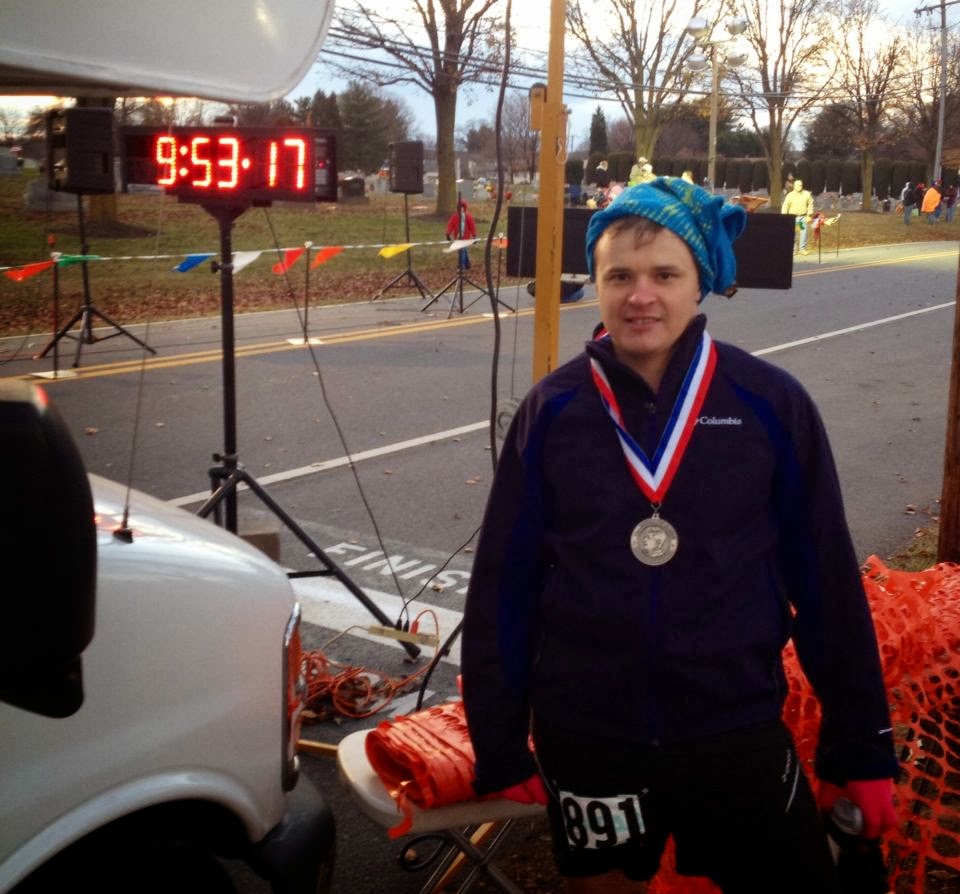 Fa thump, fa thump, fa thump was the sound of my forefoot and mid sole strikes echoed by the rhythm of my breathing ha whoo, ha whoo, ha whoo and finished with the feeling of my heart beating kwa fump, kwa fump, kwa fump. It is hard for the rhythm of contact with the land, lungs and heart beat to synchronize so effortlessly, but that was how I felt as I powered through the thirtieth mile of the JFK 50 miler. That is the point when I know I can finish, but something different occurred this year. I was having an amazing day with nothing noteworthy to complain about. My legs hurt, but I had no heat cramps, I was tired, but extremely motivated, my brain was so taxed that I could not remember the names of the people around me, but somehow I was managing the math for all my mileage splits in my head. Everything was as it should have been for the strongest run in my life.
Usually this point is a reckoning and the finish my sole motivator, but this year I went into beast mode. I grunted in a primal desire to push forward. I was right where I wanted to be, still very tired, but from worthy effort and I repeated a mantra that had gotten me to mile thirty so strong physically and mentally. "Let yourself have a good day." Sometimes it is hard for me to have positive outlook. It is hard to believe that I can have good days. Sometimes in races like this my worry over an unmanageable low point will sap my energy, slow my pace down, and make something I love to do burdensome. People tried to pull me out of my race though.
"If your were in track club you would definitely run intervals and you could run sub 9 hour pace... I usually run that pace."
I am always annoyed with people who tell you they are having a bad day when you pass them. I could have got in my own head, but I waited for a rugged downhill, pulled away and said:
"Well, I run trails, mountains and stairs because that helps with me PTSD. My biggest issue is preventing panic attacks on runs so I focus on that. I seem to be doing great today, and I am just happy that all the causes of my panic attacks left me with my life, arms and legs. I am lucky to have days like today." He was apologetic, but I was too focused on the trail to acknowledge it. I did enjoy nothing-ing his attempt to correct his previously callous statement.
Most of the time I think it is in poor taste to over share these sorts of personal details with some random person on the trail, but in this case I was pissed off. However, like my injury at Bradbury Mountain in August I had earned a great day through all my hard work. Just because that guy ran harder last year didn't give him a pass on this year's lower level of training. I thanked Chick Hill again for all the rugged 7 minute mile paced rocky downhills that made this separation so easy and a conversation that could have been unsettling gave me a lot of confidence. It was a real battle this year to shave 55 minutes off of last year's finish. It took so much focus and discipline to run the first leg of the Appalachian Trail (AT) in a way that maxed my ability to climb with the fact that an elevated heart and the thick fall air were common triggers for me.
I ran on the razor's edge between hard effort and the prevention of a panic attack. I could do this because I trained myself on the terrain that most reminded me of combat and the explosion that gave me mTBI that inevitably made me a civilian. I wasn't going so far as criticizing someone's performance, but I had worked so hard and through real adversity. I wasn't going to have some track club split counter tell me how to train and run my race. On my second ultra I has used that style of training plan, but it landed me in an Intensive Care Unit for three days, so nothing was taking me off my plan.
PTSD and panic attacks were becoming a bit of an advantage. Running your best race without burning yourself out is a similarly difficult balancing act. A life that revolves around managing my anxiety was actually making me better on race day. But it was more than that.
I seemed to be gliding along effortlessly on the first section of the AT and the pace was not difficult until the late forties. I continued to run effortlessly on the first half of the C&O Canal. My deep longing to transcend and merge into the place I live in Maine had made my greatest strength running on rough and rocky trails. My feet slammed into rocks several times at JFK, but my balance kept me on my feet. On the single track trail my movements were light and I passed people with ease. The whole year I needed those rough trails because they were the only place I could stay in the moment. People kept complaining and I held my tongue until the last section of the AT.
"I love this shit so much... I am so happy to be here."
This made me look a like sadist, but it was true and this attitude was helping set the conditions for a great day. It had been hard and my biggest problem was consuming enough calories to keep going strong. I would eat PowerBar apple sauce and get sick for a few minutes while my digestion was competing with my quadriceps for energy. This would be worth it when the more slowly released applesauce carbohydrates paid dividends late in the race.
 |
| 28.4 miles in at Antietam Aqueduct |
I was running my race plan perfectly. Get off the AT (15.5) a little behind on pace and make it to Antietam Aqueduct on pace. I came of the AT at 12:49 pace and by Antietam I was at 11:49 splits, 14 seconds under 12 minute mile 10 hour pace. I gained about 5 minutes and I was so pumped. I recognized my pace earlier in the day, but I would wait till the last twenty miles to really grind at max effort. I can't describe the joy that comes when you do something as hard as run fifty miles in under 10 hours, and how amazing it feels to still have the fortitude to push harder in the last twenty miles. I invite anyone who thinks PTSD is a syndrome of the weak to line up with me next year and call me weak on the back twenty. At this point going that hard simply maintained my pace at 11:49. I was outside of myself, though the last 8 miles of road and high winds was miserable. I was tired, cold and on cloud nine. I kept a run down hill and straightaways, and walked uphill until I reached the last mile and a half. I must have clocked a 10 minute last mile because the finish line came quickly. I looked at the clock and it was 9:50(:32).
My wife was waiting for me and we were so excited. I let out a guttural yell, as if I was some medieval knight after vanquishing all my foes. I waited for, one of my living heroes and founder of Team Red, White and Blue, Mike Ervin to cross and as I cheered his equally amazing accomplishment. I never thought I would ever be able to stay in front of such amazing runners and leaders on veterans issues, it is still hard to believe that the day was not something I imagined.
 |
| http://teamrwb.org/ |
When life is miserable it is so much easier for me get stuck, but it is often what I do in the low points that sets the conditions for when I feel stronger. Its hard to run my race, suck down my applesauce and just let my legs keep going. Having PTSD feels like running on a gnarly, rocky and mountainous trail when everyone around you is on a smooth surface. Yet when I am on rocky trails I am in my element, and everything feels easier when I recognize how much harder life is for me. I need that perspective. At the JFK 50 Miler most the people around me left the AT demoralized while I left fired up, and easily made up my pace before my toughest push. I had time in the bank and chipped away a little more time in the last ten miles. PTSD keeps me in the doldrums a lot more than others and I often have to say things like, "just manage this low point Joe." Sometimes when I am in the toughest place on my path and its important to let those momentary set backs be momentary setbacks. Sometimes I struggle because the path is rocky, but when I manage my low points I sometimes find myself at Antietam Aqueduct with time in the bank, feeling amazing and surging forward because I did everything I could when the path was harder and everything was a lot more difficult. The contextually accurate positive self talk that guided me to an amazing day was just a representation of a coping mechanism that I have developed over months of practice. Managing PTSD is extremely difficult but it has taught me how to thrive in some of the most challenging of circumstances.
*Ultra Runner Geoff Roess is known for focusing on the low points on 100 mile races. It keeps me going every time I have a rough day.
Subscribe to:
Posts (Atom)