April 13, 2019

Importance of an Empathetic Therapist for Chronic Traumatization

Finding a compassionate and empathetic therapist is a must to heal from trauma.

Vets, if we do not develop a connection with our therapist, it’s unlikely we will keep our appointments. If missing an appointment call to cancel, and reschedule, so another vet can take your place.

There is no time frame in healing from war trauma.

We may feel an urgent need to purge, or have a sense of never being able to talk about our experiences. Similar to running distances we need to pace ourselves in therapy so we do not retraumatize ourselves, and return to our old coping habits.

It might take a couple of therapists to find the right one, so it’s important to keep appointments even if your not feeling secure in sharing. If after three or four visits, a rapport is not developed with your mental health practitioner, ask for a Change of Provider form at the counter.

To increase the likelihood of approval, write lack of rapport or connection, and do not feel they can help. It may take up to three months to see another therapist.

Remember, your mental health is important. Keep your appointments, and find the right person to guide you through the process. An empathetic therapist is paramount to healing from trauma.

Our emotional and spiritual centers are damaged, to find our way through the wreckage of our minds, we need a guiding hand. A ‘therapeutic window’ is an empathetic connection between the therapist and client, enabling a safe place for exploration of traumatic memories and events.

Traumatic events shape our lives, and alter the way we process information. Especially chronic traumatization, our symptoms mimic depression, bi-polar disorder, and personality disorders. We can be misdiagnosed by a less knowledgeable and skilled practitioner.

Veterans with chronic trauma need an empathetic practitioner, knowledgeable in the latest treatment modalities to take our emotional hand and guide us through the wreckage of our minds.
It is helpful for therapists to understand the implications of structural dissociation as an undue division of the personality, how it manifests, and how it must be treated. They should strive to understand the importance not only for psychodynamic, relational and behavioral aspects of treatment, but also become proficient in assessing and working with the mental energy and mental levels of patients. Therapists need to analyze survivors’ mental and behavioral actions for adaptively. (The Haunted Self: Structural Dissociation and the Treatment of Chronic Traumatization, van der Hart, Nijenhuis and Steele).
The dissociative features of chronic trauma have a distinct set of emotional states we cycle through distinct from the others, the common symptom such as anger and rage to the less talked about emotional numbing to the different personas that can emerge from trauma states.

December 13, 2017

Complex PTSD and Out of Body Experiences

Robert Lanza, the author of Biocentrism, is a heralded biologist, and a leading quantum theorist. He posits that we live inside a galactic entity, that all matter contains some amount of consciousness. He also states that when we die our consciousness returns to the proto-consciousness that permeates the cosmos.
In 2007, Lanza published a feature article, “A New Theory of the Universe” in The American Scholar, a leading intellectual journal which has previously published works by Albert Einstein, Margaret Mead, and Carl Sagan, among others. His theory places biology above the other sciences in an attempt to solve one of nature’s biggest puzzles, the theory of everything that other disciplines have been pursuing for the last century. This new view has become known as Biocentrism.
It has been said by other scientists that this is the source of out-of-body experiences. I have had three out-of-body experiences. One time during an encounter with a bottle neck of our tanks, I popped out of my Bradley Fighting Vehicle, so that I could see 360. I was able to know where to place the rest of the brigade into protected positions.

The first time, I traveled the universe as a child during a traumatic event. When I was 5 years old a man raped me. The only memory I have of it was an Angel like being, that took my hand and pulled me out of my body.

From then on, my memory was blocked from remembering what happened. But, I knew something terrible had happened to me. My father had friends that were pedophiles, they would have parties and with all the kids over. Their parents would get drunk, some would chase the kids.

During those parties, I was raped. After, in my mind I became a superhero. I would punch, kick and scream at any adult that came near the kids. When they came running towards me, whoever was following had me challenging them. “I will kill you in your sleep!”  This went on for a couple of years.

At the age of 44 I had a hallucination so vivid, it triggered a psychotic break. My body was forced down from an unseen force. When I was on the floor wondering what the fuck was going on this time, I realized the pressure on my hips felt like giant hands. I started screaming, as the fragmented memories came back. He was in me again.

I have one alter, so far. He is 5 years old and very mischievous. The only time he has taken control of me as an adult that I know of, was at a bar with some friends in a blackout drunk.

I only remembered after my friends explained my actions to me. When they described what I did and said, some of his memories came to the front. It was the childish behavior and thoughts coming to me that allowed me to know his mind. He was separate from me. It was him that was in control of my actions and perceptions that night.

The kernel of my traumatizations is finally revealed.


April 19, 2016

Fear and Loathing in Iraq

Fear and Loathing in Iraq

...see if I can remember
hold on..

Act One:

We gotta address
the silence,
taking us out.

It’s an honor
to mediate
the psychology
of death.

To witness
an
atrocity
is a
life sentence
of
suicidal thinking.

To atone,
live,
die
or share.

Act Two:

Boom!

Driving under
the hump of night,
streaking red lights
across the sky.

Rocket plum-trails
flung,
strings of clouds
illuminated by flights
of fire.

Over the oval
periscope
night vision screen,
white interior
tan armored can.

Ordnance ringing
shock waves
and
reason escape
toward
my steel embrace.

Make a living
they said,
a button and bomb
war
you say.

Not by my witness.

On the
ragged edges
of thought deception.
With
canyons
of memories
gone.

Over 24,000 dead.
In a
three day
glory orgy
massacre.

An angry
long-range rocket
glare.
Depleted uranium rounds
beware.

Act Two, Scene Two:

Public relations
Downplayed
the ground war.
Oral history
Against
the
idiot box
repeaters.
Sling back
my pain;
hung, slung and sprung
for you.

With a twisted retort
they say,
“...you know,
smart bombs
bursting in air...”
On soldiers
without a chance,
eating bags
of rotten tomatoes
and not enough rice,
or ammo
for a fight.

100 hour ground war,
Infantry
pointing tanks
to kill.
A Saudi oil storm
and the
oligarchy
holds our hands.

Keep it in the ground,
or genocide the world.

Act Three, Take Two:

172 hours
straight,
to witness
a three-day
massacre.

We
were out of range,
They
were not.
On the edge
of insanity.

Little green men
running around
on fire
in my periscope.

Part Two, Scene Three:

Infantry
guiding our tanks
into place
to fire upon
tomato eaters.

Best path
for a contingent
of
Apache's and Warthogs
strafing,
pinning them down.

Apaches out front
raining hellfire
And a
50 cal machine gun
Hammering
little green stick men
into the ground.

Part..:

I cannot fucking remember
until waking dreams
and nightmares.
Scanning sectors
and
best kill boxes.

So many
lost
to the edge.
An alternative reality
next to you.

A Lost Scene;

Where I was
when you asked,
"...you okay?"

“Yeah...I'm okay.”

Another gurgling
conversation
I'm missing.
They don't want
To hear
why
cluster bombs
are bad.

Private Dumbass
and I were walking
through burned out
hulls.
Got my section covered
when he says,
"Hey, look over here!"

With his leg
cocked back
attacking my eye.
I grabbed him
slamming him
in my sector.

A
shiny can
with
Eight spider legs
sprawling out.

Cool!

I'd wanna kick it too,
if I were two.
He thanked me
after I said,
"You almost got us
both killed!"

Epilogue:

I am a container
of that which splintered
singularly,
forcing the aperture
through which
I find my reality.

We tell a soldier or veteran
of war
Welcome Home
Because
the battle
never leaves us,
as we return
from conflict
every day of our lives.

My shit
still tries
to kill me,
my war
1991.

Scott A. Lee © 2016

#veteransuicide  #22aDay  #MoreLike55aDay  #RaiseAREDflag

March 9, 2016

PASP on Letting Go of PTSD

Life can only be understood backwards; but it must be lived forward. ~ Søren Kierkegaard

If suggesting that letting go was actually the best and easiest option, then the world be a different place and I would of “fixed” myself long ago. Might as well hand the novice a boomerang in a shaming pose and quietly say, “Throw it.”

I have been angry for most of my life and all too often I take it out on people close to me. When my mother was alive, she carried the brunt of my rage. I did not know why but back then it felt like she was the source of it all. It probably kept me out of prison. On some level she may have known, and took my verbal abuse. Betty was an anger sink for me, keeping me safe when blaming and railing against her for my vulnerability.

With my mother, I wasn't jesting with the world against the stacked house of facades we call society. Done enough, you may find your face filleted. If you are lucky, I'm told. I was better able to fair storms when she lived. When veterans and families have a strong support network, living with the consequences of war is hard enough. For those with little to no support, or loose it they will more often spiral out of control.

I am not here to deny that most of it was my wreckage, nor get into a trolling fight with agents against change. Mind bending, while great for special effects on an unattached screen it is better coped understanding what to expect. I am here for people with PTSD and other brain injuries to navigate the vortex of inner experience in hopes they can better cope.

The house of facades becomes a disorientating sea of emotions, memories and nightmares lost in the waves hurt, delusion, pain and rage for vets with Complex PTSD and Moral Injury. Any one distortion to our self-image could trip a hallucination, attack with your delusions and I

Hurt can become a stoking force under bridges. ~ Scott Lee

Moral Injury, it tries to kill me most days. For us trusting comes too quick, or not fast enough. Hurt, can become a heat sink drowning out reason and clarity. It is rooted in my hate for me, I get that.

I see the struggle for people to take the amount of sorrow silently exuding from my pores. Imagine the internal state one must carry to radiate this energy. It is uncomfortable, I get it. Let's not forget the lion tongue cuts both ways, see my face.

One of the best medicines I have found, is the person willing to sit with you in your sorrow. Whether I am raging at unseen forces, or help me brave the deafening silence.

The crashing waves atop the sea looks scary, to you. I know the unrealized terror of the undercurrents, invisible to the reality above and carry the most power. Where we begin to see scary sea swimming on top, my third eye is constantly churning. Just because we don't talk about it or have a good day, does not mean we do not think about what we did and saw every day.

Not one vet deployed to combat and seen or participated in inflicting high casualty rates comes back unchanged. Apathetic, angry at everyone, betrayed by the media and government on all fronts. Why wouldn't we feel apathetic to your plight, when our problems kill us? We get high profile "veterans" organizations pulling in multi-millions, but those vets get rock star treatment while it's filmed for promotional purposes.

Stop telling veterans to let go. The only way to let go of PTSD is by death, and too many veterans succumb to the ravages of posttramatic stress. I dare say few of us give up, more like died while waiting on care. Someone care now?

February 7, 2016

Veteran on the Edge

This post is inspired by reading Patience Mason's PTSD Blog about her new book idea. She asks, "Reality is that most people who come back from war, or survive another trauma, are not fine, so if that might fit you, here are some questions to think about: How or why might you be fucked up?"

Dear Joe Public,

I would doubt you were in the military or a veteran if you could not recite two or more times a curious and insensitive clod trampled through your trauma to relive his boyhood romanticized thriller of the military life.

For the insensitive thinking that leads a stranger to ask intimate questions, and then discount my story because it does not match the official narrative. Even though most know the television and government lies about everything.

I am not fine. Why the fuck would you expect me to be? Because my war was a little war and does not matter? I hear this all too often, recently and even from veterans.

I am angry and full of rage when not numb or heavily medicated. Hear my witness, in three days my brigade killed over 24,000 Iraqi soldiers under the Desert Storm.

When I got home the idiot box repeaters called me a liar further altering people's perceptions of me as unstable. Caregivers know the safest people in the world are standing next to veterans with PTSD.

When I got home it took filing seven times with the Veterans Administration to get a 0% service connected rating for hearing loss.

In 2005 unchecked PTSD led me to get stabbed in the face and precipitated a crisis. Hospitalized for two weeks in psychic ward and then transferred to a two-year intensive treatment center for veterans.

It took the ninth case, to get a 30% rating for PTSD. Without the support from the treatment center I would not be alive or have a stable life.

Fast forward past the bouts of homelessness, and over 12 hospitalizations for suicidal ideation, in 2007 and the eleventh case, I was finally awarded an 80% service connection for PTSD, hearing loss and tinnitus. Which seriously exacerbates PTSD and infuses the flashbacks and hallucinations with sound, when I am doing deaf.

Do not ever forget. I participated and witnessed in a massacre. For I cannot. My mother shared stories of our great-great grandmother walking the Trail of Tears as a child. I now know her level of sorrow, a lost Cherokee of an unknown clan, branded with genocide where the past meets the present.

Today, if I make perfect financial decisions every month I can barely get by. But, I am not only human and prone to the same mistakes and stresses everyone faces. That is a base for a veteran with combat PTSD, MST and TBI, welcome to our good day. Now heap on hyperstress and crippling anxiety that literally makes your skin crawl. Welcome to our good day. For a great day, heap on cannabis. I don't make enough money to have that the whole month though.

Why the fuck would I shoot bullet eyes when you ask, "Are you okay?" No, I am on the edge. Are you ready to listen?

January 7, 2016

Cannabis and the Veterans Suicide Tsunami

By 2014, waves of soldiers surged in the tides of our modern wars, with 2.7 million veterans lost in the detritus of conflict, as compared to Vietnam's 2.6 million. Both populations amplifying the undercurrents of the veteran suicide tsunami, inundating our communities. Post-traumatic stress disorder (PTSD), the third highest psychiatric diagnosis for returning veterans, erodes buoyancy and dulls surfing the edges of sanity. The veteran rates of PTSD are 9% when returning, with a sharp liquid curve up to 31% a year later.

Swimming in the undercurrents, therapists report higher rates where 50% seeking help, only half get minimum treatment, thus triggering a seaquake spraying untreated veterans across communities, prisons and institutions. Army vets wash up in 67% of PTSD cases, where 19% received a traumatic brain injury, and 7% have both. Preceded by the military suicide epidemic, add bias in reporting veterans accidental deaths, plus under-reported statistics and treatment, and no central data veterans ride the white-capped waves suffering in silence, through ineffective systems, pour in poor record keeping from institutions, sets a consummate storm.

In the deep-sea of misery, the re-experiencing of vivid and graphic memories take form, in and out of reality. Often no memories and sometimes we cannot forget, a deluge of fears, repeating disturbing intrusions, running from bombs and bullets the green ghosts skip across the periscope screen. Studies point to previous trauma with increased risk and severity deepens when the soldier killed, failed to save a comrade, handled the dead, and saw atrocities. Tumbling further for veterans incarcerated, victims of military sexual trauma (MST), multiple deployments, childhood traumatization and or have substance abuse issues, all increasing suicidal behavior and risk taking. Rising tides in women veterans issues, higher rates of childhood abuse, MST, domestic violence and assault combined with combat increases the stress response and plunges with amputees and prisoners of war, where 37% are more likely to succumb to suicide. To cope, many veterans self medicate, often leading to substance abuse and an exacerbated mental health.

Where 39% abuse alcohol and 3% harder drugs, an increasing number of veterans are turning to cannabis to quell the agitating flashbacks, regurgitating anxiety attacks, gushing nightmares and flooding dissociation. Veterans using cannabis to quell the storm, report higher coping and increased resilience, significant anxiety reduction and a better quality of sleep, plus a full range of emotions to include joy and happiness. The hypothalamus and amygdala mediate stress through the endocannabinoid and limbic systems, tripping or skipping over the flight or fight survival mechanism. Cannabinoids function in fear extinction, role switching, and regulating the neuroendocrine system governing behavioral responses, resetting the mind's ocean; with calm, deep and cool convections. To quell the veteran suicide tsunami claiming 112,000 lives in the last 14 years, make cannabis legal and available to veterans.

August 12, 2014

A Veteran Father Struggles With Family Court and Child Support

When a person walks through the doors of a Military Entrance Processing Station, they know they are signing a contract that gives their mind and body to the military. Most believe it is for a set period of time. For many, the contract is lifelong as the effects of being in the military follow them the rest of their lives.

When a soldier, sailor, marine, or airman is deployed, more is lost than the every day mundainness of life in the United States. Military personnel leave behind home, friends, and family. Often times this loss is permanent but not because the soldier is killed in combat. Most often, losses are because of the strain of being in the military and the effects the soldier carries with them.

The media is quick to jump on stories about military suicides, combat deaths, and active and veteran military members going on a homicidal rampage fueled by PTSD. This is what gets headlines and ratings. This is what people click on when looking for news on the internet. This is what people post and repost to social media. The bloodier and gorier, the more the story is shared, commented on, and used for political issues like gun control.

What happens when a veteran with PTSD is faced with the loss of their home and family? Where is the media then? There are no ratings or headlines for veterans who fight for their rights as parents. A father who is fleeced of his disability pay because courts use past employment to calculate child support is not newsworthy. A man with a bonified disability is discriminated in our countries courts is not a headline when the disability is PTSD. False accusations are believed because the father was labeled with four simple letters.

Where is the outcry? Where is the balance of justice? Courts have spent decades ensuring father's get equal treatment in custody and child support cases. But because lawyers do not understand PTSD, and judges base their opinions on sensationalized headlines of an extreme minority of cases involving violence, a disabled father risks losing his children after already losing his home because he cannot afford child support that was erroneously calculated.

We are not talking about deadbeat dads. We are talking about disabled military veterans who are also parents. Cecil Ranne is one of those fathers struggling for his rights as a parent, and rights to support himself and his children in spite of a disability as a result of his military service. Years after his divorce, Ranne is still fighting a miscalculated child support order while supporting three children with another on the way. Now, he faces jail time for lack of payment for one child in the custody of his ex-spouse.
The amount awarded is in excess of $1300 per month. Shortly after filing for a divorce in 2012, Ranne lost his job and has supported himself and his three other children on his military disability. Despite dozens of attempts to work within the system to get the order modified, Ranne is caught in the child support vortex many parents face who live in one state while the ex-spouse lives in another. Instead of child support services working for the good of the family, child support services in several states are passing the buck amongst themselves causing Ranne to overpay, double pay, and have little to no chance of getting the erroneous order modified and avoid jail.

Each state claims Ranne's issue is the problem of another state because there is an open file in that other state. Oregon where Ranne lives, has decided to harass him for back due child support instead of helping the disabled veteran get things straightened out. Montana, Colorado, and New Mexico pass Ranne off as not being their problem. In addition to passing the buck, each of these state's child support office and family court have apparently forgotten their obligation to assist Ranne through this process per the Americans with Disabilities Act (ADA).

According to the ADA, courts and agencies are required to assist persons with disabilities in completing paperwork and making sure the disabled individual understands everything that is part of the court process. To date, Oregon Child Support Services and Family Court has refused to abide by the ADA in Ranne's case.

Cecil Ranne has PTSD from his two deployments into combat for the United States military. He is not violent. He is a caring and diligent father. He is trying to support his family despite his disabilities. But because of sensationalized media headlines about "crazy" and violent veterans, Ranne has been stereotyped and resultingly discriminated against by a system that purports to act in the best interests of the family.

Where is the media? Where are the headlines? Where is the ACLU when a war veteran carrying the burden of his service to the United States becomes a victim of the United States court system? Where is the justice for a disabled veteran who is also a devoted father?

People enter the military knowing that they are potentially signing away their lives to their country. They did not sign away their civil rights. They did not sign away the lives of their children. Veterans carry the burdens of war. They did not sign away their humanity.

July 9, 2014

Profiling Veterans with PTSD

Profiling Veterans with PTSD

After serving our country and defending the freedom of this nation, Veterans are faced with PTSD profiling. The stigma accompanying service-related Post Traumatic Stress Disorder is a difficult obstacle for our Vets.  Inaccurate and demeaning images of veterans in the media are casting an undeserved shadow over our nation’s heroes.  Veterans need our utmost respect and care, instead of chastising them for injuries received while fighting our country’s battles.

Earlier this year Kevin Bowlus’ case was dismissed in Illinois after his testimony on being treated for PTSD.

“When she found out I was fighting for my stepson and was being seen at the PTSD clinic she dropped representation the day before a court hearing.”
-Kevin Bowles

Veterans often have their diagnosis used against them in court violating their rights.

Kevin, a Navy Veteran is fighting for custody of his son and his stepson due to an alleged unsafe environment caused by the children’s mother. Absent till now, the biological father of the child has come forward.  The child has been under Kevin’s primary care since he was eight from infancy, till now.

In May, Kevin decided to end his alleged abusive r In May, Kevin decided to end his alleged abusive relationship with his wife and the children’s biological mother.  Despite the marriage ending, he still wants to continue as primary caretaker for the children.  He filed for a protective order against the children’s mother and it's proving difficult for the courts to see beyond the stigma and misunderstanding of his diagnosis.  Not his actions, if it were for that he would have his children.

                                                Photo courtesy of- www.umkc.edu


“The police didn't believe I was a victim”
-Kevin says

After appearing before the judge, Kevin was awarded an order of protection.  When the police
attempted to serve her with the order of protection they discovered she took the children.  They found
her in Kentucky with the biological father.  The mother signed over her rights to the biological father 10 days after the order of protection. Kevin’s estranged wife was then severed the order of protection and Kevin was able to retrieve the children. Kevin adds, “Thankfully the police here blocked their attempt to recover my stepson citing the protection order.”

“I have been attempting like hell to get help for these kids from all avenues of government but here in Illinois stepparents have no rights.”
Kevin states

                                                                         Image courtesy of stopsoldiersuicide.org

Kevin is awaiting a hearing for the order of protection in Illinois on July 8, 2014.  Both children are in Kevin’s custody pending the results of the court appearance.  He expresses deep concern about the upcoming court date stating, “It is boiling down that I may have to let this child go with a person with a violent history, and no one willing to protect him.”

As of Friday, June 27th Kevin was still in search of an attorney to help with his upcoming case in Indiana. “I am still scrambling to find another one and with no funds that is kinda hard,” Kevin explained.  Thankfully a caring team at the Veterans’ PTSD Project and an anonymous donor has come together and to help cover the cost of Kevin’s legal fees. This act of kindness from fellow Veterans and the donor allows Kevin to have the proper legal representation in his pending case to secure the custody of his son and stepson.

We are still awaiting the outcome of Kevin’s Bowlus’ upcoming court appearance.  The fight for this Veteran’s children could potentially boil down to the stigma of his service-related injury overshadowing his ability to parent and care for his children.  As Americans we need to band together and follow the lead of the Veterans’ PTSD Project and anonymous donor and take a stand to help veterans in need.  It’s time to stop profiling veterans and start supporting America’s heroes.


Written by Rebecca Monahan
Blogger & USMC Wife     


June 9, 2014

Satisfied With My Best Effort (Syndrome of Survival)


This last Saturday I failed to finish my second attempt at a 100 mile race.

As I winded through the repeated switchbacks on the TARC 100 from mile twenty five to thirty I became increasingly aware that I was more and more disoriented. After three years of ultra running I had manage the first 85 degree day of the year as well as any central Maine resident could. Because of the heat I started cramping at ten miles, and I troubleshooted it with extra water, electrolyte pills and more calories than I could stand in the heat. I was strong physically but every time I ran I would heat up and cramp, but after I hit the marathon mark I started getting disoriented. Heat cramps were rapidly turning into heat exhaustion, but if I could only make it to the night I might have a chance...

My Ranger brain was on point, I was outside myself worrying about my weakening cognition. My limbic system in was kicking ass despite my cortex being massacred by the heat. I was both dizzy, less aware of my location on a map, as well as outside of myself and increasingly aware that failing to make it to the next aid station might be dangerous. In other situations I might have tried to take a more direct course towards support,  but I knew that I was not reliable enough to do my own navigation. I was paradoxically disoriented and present at the same time. In my miserable state I had enough composure to know that I could no longer trust myself to do anything but keep moving on the course. Despite being delirious at thirty miles they were able to drop my core temp, by spraying me with a hose, and after sitting for five minutes drinking all I could and being offered ice (which was only available for medical issues). I ran some more.

I had trained hard, and instantly picked up my pace passing several runners that transitioned better in the aid station. However, I drank my water bottles so fast that I was out of water more than a mile away from the next aid station. I kept saying to myself "when are the fifty miler runners going to pass me" but everyone was crippled by the same heat. This mile and a quarter took thirty minutes, and the dizziness returned. Dehydrated I tried to rally again, but I couldn't seem to cool down. When a medic cooled me down I nearly went into hypothermia, and was advised to call it a day. I obliged without regrets.

In  the days that have followed I have not been disappointed because, when you give your best effort and fail, there is nothing to be unsatisfied about. My Fitbit sensor recorded 4690 ft of elevation gain and 35 miles of running. My worst day was ten hours of running, and was still something to be proud of. Subsequently looking at the stats also made it apparent that I ran precisely according to my plans, based on my steps per minute. Typically I would have covered 42-5 miles and would have arrived at aids stations more rapidly.

I am not a fan of PTSD as an excuse, but taking diarrhetic medications for PTSD and mTBI has make heat especially hard for me to regulate my temperature in the summer.  I also have a history of heat injuries of high dosages of antibiotics in Ranger School for cellulitis, and the high heat of swamp patrol, made me pass out with heat exhaustion during a long movement in Florida. On my second ultra I had similar issues only to spend three days in the hospital with rhabdo. PTSD is also linked to inflammation that compounds heat regulation. This is not an excuse, it is something that makes me proud to have fought so hard for the thirty five miles I managed to complete rather than disappointed about the sixty five miles that never could have been on a day like that. This year it did not heat up until my rest period so there was no way to employ my more typical stadium run for heat management, though in the winter I trained inside with maximum gear to train for the June race. I hiked easy for ten miles in Acadia last Saturday and walked Darby during the hottest part of the day (there were streams and rivers for him) all week, but my acclimatization did not help at all.

Still to have the maturity to listen to my body, recognize a bad day and make a stronger attempt in the fall, or winter when it is more healthy. Being confident and aware of my limitations is as important never accepting those limitations as permanent immovable burdens. Letting my lesson be that I need to try in the winter and start with smaller distances in the summer is not giving up finishing a race on my worst days, rather for me it is learning my limits and moving forward.

Most importantly when I was on the edge of passing out with heat exhaustion my overly capable limbic system reminded me the ways that all the stigmatized "PTSD Symptoms" are so useful in times of real danger. PTSD or as I like to call it the Syndrome of Survival still works when your life is on the line. I wouldn't wish those moments on anyone so please learn my lesson, and let my miserable failed attempted at 100 miles remind you that PTSD ultimately kept us alive when we needed it too. All of that of our baggage comes from strengths and is still a resource during an actual crisis. You don't have to be as crazy as I am by running ultra distances to learn how to yield the fruits of trauma as well as the sorrow.

April 21, 2014

Iraq Did Not Create the Fort Hood Shooter

There is an increasingly troubling narrative that essentially argues that service in Iraq and Afghanistan explains the criminal behavior at Fort Hood. This is an over simplification of most veterans with PTSD who will never commit a crime, but moreover a profound misunderstanding of the nature of counterinsurgency in Iraq. By doctrine we were deescalators of violence not perpetuators and we most often recognized that our best weapons "did not shoot." Any Iraq or Afghanistan veteran will tell you, if you take a couple of minutes to talk to them from time to time, that most tense situations in combat were dangerous situations caused by unidentified enemies and US forces refrained engagement because of a lack of positive identification. Units that departed from this course committed crimes, and were the exception.

The most tense moment for me occurred in just this way, and I have been hesitant to publicly discuss the night of my worst concussion because the situation got heated and there was some understandable personal tensions going on, though only momentary, and that I may seem like I am criticizing other people. That is not the case, I am going to describe an awful situation when everyone had the right intentions, and calmer heads prevailed. This will emphasize my roll because of the limits of my own memory, but I will assure that just as many or more times other soldiers, non commissioned officers of superiors played similar roles. You might assume the situation to be exceptional, but I think that day gets to the marrow of the US Army's, at company level, propensity to deescalate violence rather than perpetuate it in Iraq. The argument that we are more violent is a profound misunderstanding of what we did in Iraq, and more often we chose non violence. Anyone using our war as an excuse is exploiting a popular idea base on very little material evidence.

My worst of moment of Iraq was after a suicide bombing, but the second worse occurred after and IED blew up and convoy of Bradley's while my platoon was set in over-watch to prevent just such an attack. I have not now, nor will I ever feel like a greater failure, than watching a piece of dirt that I had personally been observing for six hours with multiple soldiers pulling rotations blow up right in front of me. In the moment I could not even see it. The force of the blast was faster than my brain's ability to process the image and I was thrown down a stairwell by over pressure. I fell face down and I came to face up, as if it were glitch in the matrix. It could not have been a second but I lost some consciousness. I was dizzy, very confused, but a Lieutenant with eyes on IED. The platoon of Bradley's was from another battalion passing through our area so they had no idea that Americans were occupying our building and mechanized and airborne units use different night optics. Concussed or not we could all die if we did not immediately mark our position in every way possible. Their fire discipline saved our lives, but we we would be tested the same way very quickly.

Local Iraqi Army or Policemen ran to to occupy a road block to the north of the attack, but their winter cloths made them hard to identify. Balaclavas and no helmets made friendly force identification nearly impossible, and created very tense moment with a few of my soldiers fearing an insurgent attack. Simultaneously on my radio, my company commander was very unhappy that bomb blew up right in may face. Why wouldn't he be. I certainly was not happy about it and to this day I second guess myself about that night. So while dealing with dizziness, disorientation and terrible situation I was simultaneously getting my ass chewed and preventing soldiers who wanted to fire on what they thought was a very legitimate threat to our security. These soldier were woken from sleep by bomb less that 50 meters away, so anger was par for the course, but the enemy did not usually sit in the middle of the street and gaggle up like Iraq soldiers so I wanted to take the time for confirmation. Everyone was angry from the lowest private to the battalion commander and tempers were hotter than they should have been on the radio, mine included. Not hotter than human beings woken up by a bomb at 4 AM though. However, despite all of anger and frustration everyone's actions were exemplary. My soldiers wanted to fire, but headed orders, I kept command and control until my platoon sergeant got on top of things and until a my commander was on the ground. After they were on top of it I actually put microphone up because I was getting really loopy and having trouble grasping the basic geographic layout.

People say that no one trains you for days like that, but the truth is I was trained precisely for days like that. My service in Iraq was more often events when I was attacked and had no clear enemy to engage so I waited for better opportunity rather than risking the lives of innocent people. So I cannot by any stretch of the imagination understand how Iraq, and the war I fought could be a source of anything, but level headed others centered decision making under the most adverse, frustrating and enraging situations. Frankly I am sick and tired of being compared to criminals because I have PTSD from all the days that I made the emotionally draining, but the ultimately least violent decisions only to be characterized as some non thinking killer with no human agency or power over my situation in Iraq and its aftermath. I was then and I am now, like the vast majority of other veterans, making the best of a far from ideal situation, and I am beyond frustrated that every-time another mass murder happens all people with mental illnesses are lumped together with an incredible minority of violent criminals. Especially in the wake of war of occupation and counterinsurgency that stressed nonviolent outcomes whenever they could be attained.

March 31, 2014

Hombrewing as Creative Expression and a Seemingly Counter-intuitive, but Effective Check to Alcoholism

Like most people who come home after deploying to Iraq or Afghanistan I have struggled with alcoholism in the past. By a complete accident I have stumbled onto a great mechanism to develop a healthy relationship with alcohol. My roommate and I took a trip to Germany with a fresh round of deployment money and it opened my eyes to beer culture. I had already begun an obsession with Microbrew beer because of Ranger School. The best day of Ranger school is the party at the Gator lounge at the close of all training. I figured if we were limited to two beers than I would drink expensive stuff. Before Ranger school I disliked beer, but I began to really get drawn into the microbrew scene.

My wife noticed my love of microbrew beer and quickly bought me a homebrew kit for Christmas. When I started brewing I developed a much more nuanced and complicated appreciation to the subtleties of flavor and ingredients in beer.

To say it simply good beer tastes good and that leads you to drink more slowly in order to better appreciate it. Great beer is even better. By developing a greater affinity for the process of brewing and all of the differing factors that lead to a great beer, I began to start having more control over the temptation to numb my senses with alcohol. I also began studying home brewing and reading the books written my microbrewers. I came to realize how the rise of light beer increased binge drinking and that the growing microbrew movement regularly spoke out about alcoholism. Only an idiot would waste a great beer shotgunning chugging or funneling it.

Avoiding drinking altogether is a hard pill to swallow for some, but anyone can come to appreciate drinking good beer. Brewing helps one develop a healthy attitude about alcohol.  Microbrew beer more expensive and it is harder to afford binge drinking it. For me home brewing has also served a means of creative expression that seems to balance me out a lot and overtime I began to realize that I needed more direct outlets, like this blog.

As a historian I used the analytical side of brain a lot and brewing helps me flex my creative muscles. I am often at loss because grade school did very little “boy or culturally masculine art” and I think this is a problem. For soldiers it is hard to express our feelings. As a historian I think the rise of masculine brewing culture is funny because in Early America women dominated the brewing of homebrew. I might be a feminist, but I can ultimately never escape a lifetime of bombardment by ideas as to what constitutes toughness and manhood. Military training has conditioned us to suppress emotion so hobbies that help us express ourselves are very useful for our return home.

Home brewing is a way to express ourselves in a way that respects our sense of toughness within a masculine cultural ideals. Better it should help us develop an appreciation for alcohol and not an obsession with drunkenness. It is also a hobby that is cost effective (I dare you to try and find another one) and one that you can spend a lifetime getting better at. You can easily brew beer that would cost $3 a bottle in batches of 48 bottles costing a total of $60 (this averages $1.25 per bottle), so after three batches you cover the initial investment.

Every batch of beer I have brewed in the last four years has employed a new technique. Today I am trying a special chemical that eliminates gluten without forcing you to use the awful sorghum syrup. Brewing makes you realize that beer is a living and breathing thing. This fosters a sense of creation and an appreciation for life when I brew it. Its a hobby too, so in the past I have been extremely meticulous, but today I brewed during a busy time, so I just threw things together from memory without measuring anything and trusted my instincts. Like anything else, it has taken me years to be able to just throw things together intuitively so I wouldn't recommend that early on.

This certainly would not help us all, and I would discourage this for people with addictive personalities, but it is something I have come to really value. Anything that helps you come to terms with the problems of alcoholism or any hobby that helps make you a better person is useful. I just thought I would share my affinity for brewing and how this unlikely hobby has helped me check the impulse to numb my senses with alcoholism in the hopes that it might help others find new muses or face their own problems.

February 25, 2014

The OIF/OEF Cocktail: Shell Shock or mTBI and PTSD

I am often frustrated when people mistake mTBI and PTSD because they can be so different. Admittedly PTSD is the hardest thing I face from day to day, but that is because of mTBI. Anatomically speaking PTSD is the over stimulation or use of the Hypothalmic Pituitary Adrenal (HPA) Axis. There is no simple way to describe neurology, but I will do my best at explaining my experiences in relation to my limited understanding of brain anatomy. The HPA is a apart of the limbic system which is one of the oldest traits in the human body. Our dogs and horses are some of the best aids to PTSD because we share this structure even if our cortex functioning is very different. The HPA and limbic system creates a stress response by emitting the chemical cortisol (often called adrenaline) which gives you energy (anger), pulls the blood out of your extremities in preference to organs (you will simply feel tingling or numbness in your limbs), and activates a larger part of your brain making you hyperaware. Think of the golden hour a casualty has to get into surgery, and to get fresh blood and coagulants before they start to crash. That is the final aspect of the limbic system's response to stress: the crash that inevitably comes after your body works at such high levels. That feeling of extreme fatigue and the inability to sleep is a direct result of cortisol, and also why battle fatigue was one of the first terms for PTSD.

PTSD is the persistence of this complex stress response into non dangerous situations. This interplay works with the cortex because the limbic system will provide the stressors to your consciousness so that you can more quickly respond to similar situations in the future. The HPA cortex relationship is a two way loop that can be instinctually triggered, by the older limbic system or by the cortex's memory of previously stressful events. I can see the way that anatomy and social construction works together in my memory of soldiers saying that sooner or later we are going to jump when a car back fires just like all these other guys, already favoring the stress responses of previous groups of veterans through a learned behavior, as well as reflexive reactions to triggers common to the tactics of insurgents in Iraq and Afghanistan. I was blown up in a stairwell so I hyperventilate in stairwells to this day. The anatomy of stress, the events themselves and the way that others have responded socially all effect the way we experience danger as well as the way we choose to process our memory.

But this is a post about mTBI and PTSD. How does this matter?

mTBI is actually a lot less complicated neurological than PTSD, though the experience is incredibly complicated, the concussive nature of high explosives as well as hitting ones head generally damages the brain and most effects the frontal cortex. The brain's protective coating is damaged by concussion and the cortex gets slammed into your skull. This generally erodes your whole brain functioning, but has one set of symptoms that makes PTSD a lot harder to manage. Cortex injuries limit a person's impulse control, and when a person has been exposed to serious life or death situations they are more likely to have a cortex that always fires up the limbic system's response to any stressor. Hence why for me the graduate seminar table and public speaking will often trigger panic attacks. Also the anger I felt in battle is worse because my cortex is not as capable as it was prior to concussions or repeated exposures to explosions. Everything is worse because you have eroded impulse control and every part yourb rain as a system is not your own. Your body is literally not yours to control. The WWI and WWII crack ups were not solely PTSD, but also damage to the cortex from shelling, because as Jonathan Shay as observed, PTSD is actually useful in combat. You always want to fight or fly, but you fight better as a unit so your trained to stick to the plan, that is until blasts and concussions add to this mix and make it harder to control the stress impulse.

You crash because we are only designed to go that hard in brief instances: the golden hour. You become depressed because you are exceeding the capability of human anatomy, and because you are losing control of your impulses. Worse cortisol damages the conscious memory when it is overused and the center of your brain that is self aware is consistently damaged. Kurt Vonnegut referred to scouts, himself included, as people that were controlled by their spinal column, shared location with the limbic system, because he understood the human brain in a profoundly human and intellectual fashion, but when the cortex is damaged it is nearly impossible to stop this life or death impulsivity.

I can remember my first nightmare and flashback like it was yesterday. I had just shot an RPG gunner in Mosul, I had a flashback that day and a nightmare that night. I knew it was PTS and I didn't care, I managed it and was upfront with the Physician Assistant about it. It was war, of course it was going to be terrible, but it was important for me to continue to do my part. However, when I got a concussion I could no longer see what was going on as natural and I got way to stuck in my limbic system. Everything was extreme and everything remains life or death because no matter how smart I can make myself my cortex doesn't have the impulse control that I once had. I can know something, but not feel something, because the emotional stress response is more powerful than my ability to control that impulse. I perform amazing feats because I am running on an extreme and then I crash because I am going way to hard all the time. I know this, but it is almost impossible to control the powerful impulse. I just hope I never lose the ultimate battle to the natural and constant ups and downs that come with the OIF/OEF cocktail.

January 15, 2014

My Case for the Syndrome of Survival

A popular argument to fight the stigma of PTSD is to abandon it as a disorder. There have also been cases for calling PTSD an injury because of damage to the hippocampus, but this is perhaps the worst piece of evidence because this scarring occurs in bi polar disorder and the entire spectrum of anxiety disorders: some caused by trauma, some not. The injury moniker's most problematic issue is that it seems to create an acceptable male, or females living up to male ideals, non mental illness. Even rape survivors are said to "have MST" instead of PTSD caused by rape in the military (why there is any effort to sterilize rape in the military continually blows my mind). However, the worst thing about injury or trauma titles is their omission of how paradoxical and complicated PTSD, Shell Shock, and Civil War Nostalgia have always been. Injuries are often a lot more simple: rest, ice elevate does very little to your identity. War alters our identity and what we have is a persistent illness, disorder or syndrome. Yet, anyone who truly understands PTSD grasps how it is the persistence of survival skills into non survival situations. Those survival skills ultimately saved our lives, but makes the mundane and routine parts of life harder to manage.

Syndromes are often permanent and the damage to our brain was not instant, it takes years of overuse of the limbic system to damage the brain's declarative memory and create the scaring identified by injury advocates. Moreover, calling it a syndrome of survival also will explain the deep longing and even nostalgic memory of war. We are damaged, but most of us possess some longing to return, and even miss combat or trauma. When we act like PTSD is solely an injury, we confuse injuries and disorders, all because of stigma. Assholes will be assholes whatever title is used, but calling PTSD what it is with respect to trauma's paradoxical complexity will help us accept what war, and survival have done to us. It will also, help war survivors recognize what they have in common with rape survivors, and that their persistent problems are extremely difficult and life altering, but they ultimately come from a place of strength, not weakness. We are all survivors and we should have a better title.

I know that this is a controversial topic that many well informed and capable people will disagree about, but as both a historian and combat veteran I have never been able to feel comfortable with any of the other popular titles. The syndrome of survival seems to captures all the complexity of survival as well as addressing lasting syndrome. Survival is a universally respected, even celebrated, aspect of the human experience and connecting our troubled lives to this ultimately positive fact will also encourage growth in all of those affect by trauma. We also need a title that people who suffer are more willing to bear publicly so that the conversation shifts, becomes broader and more substantive. A title that should come with a stronger sense of corporate pride and empathy from non survivors. A title that expresses a collective appreciation for what people have survived and the baggage that comes from it. No other title does that in the way that one crafted around survival. Survivor is a moniker  that captures the fact that we are not leaves blow about by circumstances. We survived through merit and resilience, and we can also survive the way that those original experiences have changed us, maybe even let our survival motivate us to be something better than we would have been without our horrible experiences.

December 28, 2013

Helping Others Tell Their Stories

Darby being awesome!


I hope all of our readers have enjoyed all of our regular posts, but you might not know that Scott, Travis Martin, Michelle Monte, and myself all spend a lot of our time helping others tell their own stories. Writing helps us a lot so we try and take time to help others do the same. If you enjoy the regular posts here then there is no reason why will not enjoy our Blue Nostalgia.

It is free to read and free to join Military Experience & the Arts online writing workshops.  We are always accepting new submissions and you will never be turned down without someones helping you finish your writing. The most impressive thing about this issue is not how many views it has already received in less than forty-eight hours, but how everyone of the writers wants to continue participating in the online community. Even those whose writing never makes it online, often take advantage of online support groups and being apart of a community of veterans all going through the same things. I often think about the Military Experience & the Arts's online community as this generations version of the WWI expatriate writing community in Europe. We may not live up to that generation's legacy, but there is the same sense of community, and we are always welcoming and training a new generation of trauma writers. For me it is an honor to know all these people let alone playing a key role.

November 28, 2013

Managing the Low Points "Come on Joe, Let Yourself Have a Good Day" (Thriving)


Fa thump, fa thump, fa thump was the sound of my forefoot and mid sole strikes echoed by the rhythm of my breathing ha whoo, ha whoo, ha whoo and finished with the feeling of my heart beating kwa fump, kwa fump, kwa fump. It is hard for the rhythm of contact with the land, lungs and heart beat to synchronize so effortlessly, but that was how I felt as I powered through the thirtieth mile of the JFK 50 miler. That is the point when I know I can finish, but something different occurred this year. I was having an amazing day with nothing noteworthy to complain about. My legs hurt, but I had no heat cramps, I was tired, but extremely motivated, my brain was so taxed that I could not remember the names of the people around me, but somehow I was managing the math for all my mileage splits in my head. Everything was as it should have been for the strongest run in my life.

Usually this point is a reckoning and the finish my sole motivator, but this year I went into beast mode. I grunted in a primal desire to push forward. I was right where I wanted to be, still very tired, but from worthy effort and I repeated a mantra that had gotten me to mile thirty so strong physically and mentally. "Let yourself have a good day." Sometimes it is hard for me to have positive outlook. It is hard to believe that I can have good days. Sometimes in races like this my worry over an unmanageable low point will sap my energy, slow my pace down, and make something I love to do burdensome. People tried to pull me out of my race though.

"If your were in track club you would definitely run intervals and you could run sub 9 hour pace... I usually run that pace."

I am always annoyed with people who tell you they are having a bad day when you pass them. I could have got in my own head, but I waited for a rugged downhill, pulled away and said:

"Well, I run trails, mountains and stairs because that helps with me PTSD. My biggest issue is preventing panic attacks on runs so I focus on that. I seem to be doing great today, and I am just happy that all the causes of my panic attacks left me with my life, arms and legs. I am lucky to have days like today." He was apologetic, but I was too focused on the trail to acknowledge it. I did enjoy nothing-ing his attempt to correct his previously callous statement.

Most of the time I think it is in poor taste to over share these sorts of personal details with some random person on the trail, but in this case I was pissed off. However, like my injury at Bradbury Mountain in August I had earned a great day through all my hard work. Just because that guy ran harder last year didn't give him a pass on this year's lower level of training. I thanked Chick Hill again for all the rugged 7 minute mile paced rocky downhills that made this separation so easy and a conversation that could have been unsettling gave me a lot of confidence. It was a real battle this year to shave 55 minutes off of last year's finish. It took so much focus and discipline to run the first leg of the Appalachian Trail (AT) in a way that maxed my ability to climb with the fact that an elevated heart and the thick fall air were common triggers for me.

I ran on the razor's edge between hard effort and the prevention of a panic attack. I could do this because I trained myself on the terrain that most reminded me of combat and the explosion that gave me mTBI that inevitably made me a civilian. I wasn't going so far as criticizing someone's performance, but I had worked so hard and through real adversity. I wasn't going to have some track club split counter tell me how to train and run my race. On my second ultra I has used that style of training plan, but it landed me in an Intensive Care Unit for three days, so nothing was taking me off my plan.

PTSD and panic attacks were becoming a bit of an advantage. Running your best race without burning yourself out is a similarly difficult balancing act. A life that revolves around managing my anxiety was actually making me better on race day. But it was more than that.

I seemed to be gliding along effortlessly on the first section of the AT and the pace was not difficult until the late forties. I continued to run effortlessly on the first half of the C&O Canal. My deep longing to transcend and merge into the place I live in Maine had made my greatest strength running on rough and rocky trails. My feet slammed into rocks several times at JFK, but my balance kept me on my feet. On the single track trail my movements were light and I passed people with ease. The whole year I needed those rough trails because they were the only place I could stay in the moment. People kept complaining and I held my tongue until the last section of the AT.

"I love this shit so much... I am so happy to be here."

This made me look a like sadist, but it was true and this attitude was helping set the conditions for a great day. It had been hard and my biggest problem was consuming enough calories to keep going strong. I would eat PowerBar apple sauce and get sick for a few minutes while my digestion was competing with my quadriceps for energy. This would be worth it when the more slowly released applesauce carbohydrates paid dividends late in the race.
28.4 miles in at Antietam Aqueduct

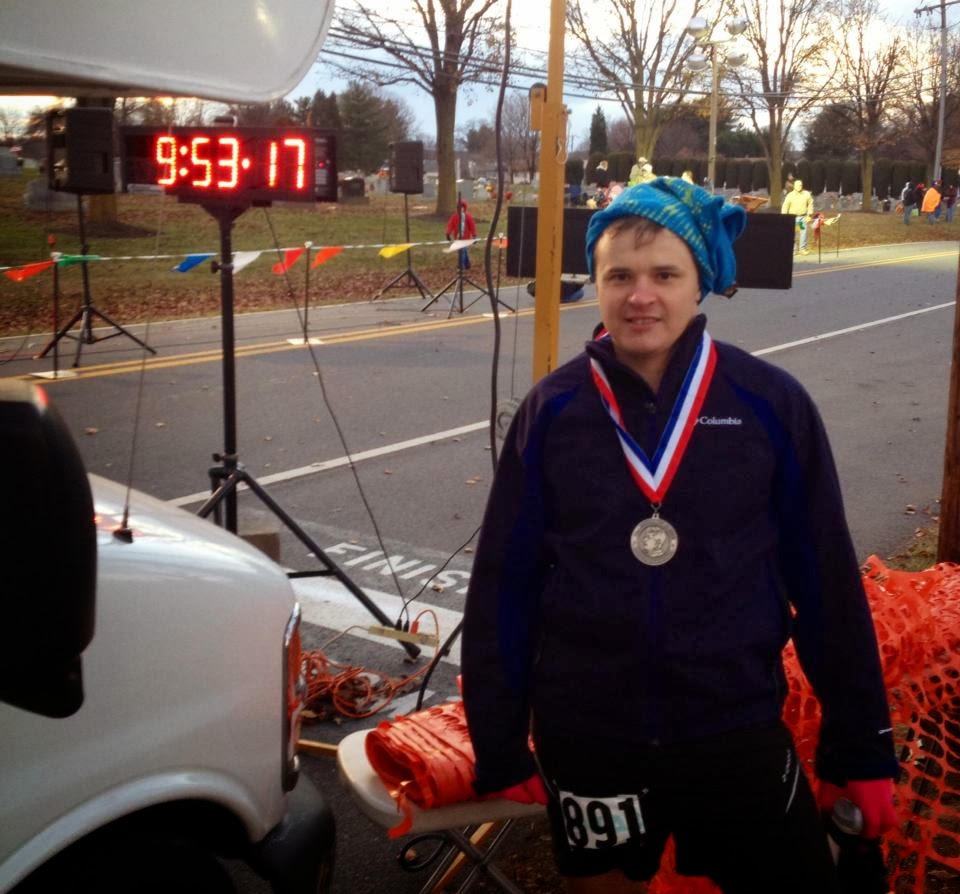
I was running my race plan perfectly. Get off the AT (15.5)  a little behind on pace and make it to Antietam Aqueduct on pace. I came of the AT at 12:49 pace and by Antietam I was at 11:49 splits, 14 seconds under 12 minute mile 10 hour pace. I gained about 5 minutes and I was so pumped. I recognized my pace earlier in the day, but I would wait till the last twenty miles to really grind at max effort. I can't describe the joy that comes when you do something as hard as run fifty miles in under 10 hours, and how amazing it feels to still have the fortitude to push harder in the last twenty miles. I invite anyone who thinks PTSD is a syndrome of the weak to line up with me next year and call me weak on the back twenty. At this point going that hard simply maintained my pace at 11:49. I was outside of myself, though the last 8 miles of road and high winds was miserable. I was tired, cold and on cloud nine. I kept a run down hill and straightaways, and walked uphill until I reached the last mile and a half. I must have clocked a 10 minute last mile because the finish line came quickly. I looked at the clock and it was 9:50(:32).


My wife was waiting for me and we were so excited. I let out a guttural yell, as if I was some medieval knight after vanquishing all my foes. I waited for, one of my living heroes and founder of Team Red, White and Blue, Mike Ervin to cross and as I cheered his equally amazing accomplishment. I never thought I would ever be able to stay in front of such amazing runners and leaders on veterans issues, it is still hard to believe that the day was not something I imagined.


http://teamrwb.org/

When life is miserable it is so much easier for me get stuck, but it is often what I do in the low points that sets the conditions for when I feel stronger. Its hard to run my race, suck down my applesauce and just let my legs keep going. Having PTSD feels like running on a gnarly, rocky and mountainous trail when everyone around you is on a smooth surface. Yet when I am on rocky trails I am in my element, and everything feels easier when I recognize how much harder life is for me. I need that perspective. At the JFK 50 Miler most the people around me left the AT demoralized while I left fired up, and easily made up my pace before my toughest push. I had time in the bank and chipped away a little more time in the last ten miles. PTSD keeps me in the doldrums a lot more than others and I often have to say things like, "just manage this low point Joe." Sometimes when I am in the toughest place on my path and its important to let those momentary set backs be momentary setbacks. Sometimes I struggle because the path is rocky, but when I manage my low points I sometimes find myself at Antietam Aqueduct with time in the bank, feeling amazing and surging forward because I did everything I could when the path was harder and everything was a lot more difficult. The contextually accurate positive self talk that guided me to an amazing day was just a representation of a coping mechanism that I have developed over months of practice. Managing PTSD is extremely difficult but it has taught me how to thrive in some of the most challenging of circumstances.

*Ultra Runner Geoff Roess is known for focusing on the low points on 100 mile races. It keeps me going every time I have a rough day.

October 14, 2013

I Wasn't Ready for the Smell...

This describes violence and will trigger PTSD symptoms. In the Terrible Moments I purposefully omitted smell because it was too much to write in one installment. I will return to it in the following post.

As a platoon leader I was ready to lead my soldiers, even in the most trying of circumstances, but when I arrived to the aftermath of a suicide bomber detonated on a crowd of civilians I wasn’t prepared for the smell. In my experience blood doesn’t have a smell at first, although it is very visible, tends to flood your memory and when it stains clothing that smell imprints itself on the memory event as it were there in the moment. In honesty that street corner mostly smelled like dirt and dust, because the explosion had picked it up off of the ground. The smell of explosives was present, I was used to those smells, but the smell of burning flesh was much more apparent and different then anything I had ever experienced (still this was muted by the overwhelming smell of scattered dirt and dust). The smell of burned flesh was like smell of burnt hair, yet exponentially grown by the scale of that terrible day in northern Iraq. This mixed with the smell of burning meat, though completely unappetizing and unseasoned. The only way I can describe the smell of peoples skin is that it was as if leather was left out in the rain long enough to fester slightly, and then it was burned, or at least how I image that would smell. The addition of the burnt clothing created an earthy smell, which was a mixture of burning leaves and grass/marijuana.

Still, no matter how traumatic the stench of death and violence was I mostly inhaled the terrible smell common in the urban centers of Iraq created by the burnt trash, raw sewage flowing through the streets, and the awful smell that the dirt and dust made as it lodged itself into your nasal passages. A not so insignificant part of the awful smell of Iraq was my body odor, because I lived in an outpost and showered weekly at best. Only that day the smell of Iraq was amplified by an explosion that wafted it through the air. Despite the stench, I refused to throw away my flesh stained boots, because I would spend a lifetime, if necessary, walking that smell away. After nine years and thousands of miles it is still there in my boots, so are the bloodstains, and the barbwire scratches I got rushing to that intersection on another night. That smell has also stained my very being as an unmovable and unalterable weight on my memory. Even during exercise my sweat pours more profusely than it did before and rather than overpowering the stench of that day the sweat contributes to it as if my every pore was endeavoring to recreate the smells of that moment. Stress sweat is more pungent than normal thermal regulatory perspiration. My body remains attached to the muted ammonia smell of muscle deterioration that comes with the body's processing of the stress chemical cortisol. I have smelled fresh cow brands and had a terrible panic attack. Anytime I smell burning hair, unseasoned meat, grass, warm sewage in a portable toilet, marijuana or the dust of the desert I am back there again: only naked, unarmored, helpless, and alone. My heart races and I can't seem to breath.

The stench combined with the chaotic sights, sounds, my internal dialogue, and physical sensations, though the smell was by far the worst of all my sensations that day (well that and feeling the weight and limpness of a dead flesh). Smells today are forever different and can send me into PTSD symptoms, often simply sicken me, or worst give me terrible migraine headaches. A lifetime of therapy and doing the right things to manage PTSD will never make that memory less burdensome. Although, I am still proud that I have refused to get rid of those boots because they are like my tattoos, a symbol of my commitment to deal with the violence I witnessed: to face my PTSD. Preserving my boots, even if they still smelled like that day in the hopes of walking them clean, was the first gesture of my efforts to face my burdensome memories no matter how terrible, with as much honor and strength as possible. The smells are certainly less pungent now, and the memory is too, at least with every attempt to understand and accept them. As if taking the time to remember that awful stench, or any sensation for that matter as it was, or as they were, reduces their terrible grasp on my life.

October 3, 2013

Another Knife in the Back: I Feel Like I did in Combat, a Pawn in a Unreal Political Game

Disclaimer: This has profanity, and contempt for politics on all sides. However, I am a person who currently supports one party over another, that has not always been the case, and try as I might to remain objective some of my bias might come through. If I could control my triggers I wouldn't have PTSD. I apologize if my descriptions, of how current politics are triggering my PTSD, appears as an attack on anyone's beliefs.

I usually have uplifting things to write, about and I am as positive as possible, but I can't get past what is going on right now. I am having a terrible week. I am getting the somatic fevered symptoms common in my worst months. It started when I presented a paper at a conference this weekend. Don't get me wrong the scholars were so inviting, supportive and did everything they could to encourage a graduate student, but public speaking is always a burden for me.

When it ended I did what I always do. Run stairs until I stop panicking. It usually takes a few terrible, nauseous, slow and miserable days to get through it, but whats going on in the country right now is making it harder this week. This week all I can think about is how Congresspersons are using my livelihood and benefits as pawns in a game. Like many other vets all the cuts may or may not hit me in my paycheck while I struggle to create a new start in a more appropriate career field. Worse it reminds me of how George W  purposefully held off offensive operations in Iraq during his reelection (a fact that was most frustrating to me at the time because I voted for him), and all the heavy fighting it caused on my first deployment. I remember the faces of men and women that died, because we weren't real to politicians. Just pawns in a game.

But like then, now we aren't pawns: we are real and we are struggling to get by. Suicide numbers had to get to 22 times a day to make the VA start taking its backlog seriously and now, because of partisan nonsense the overtime in the VBA to combat the backlog is over. All the advocacy seems to be meaningless because politicians don't actually care about anything, but political ideology. My advocacy and openness about PTSD has cost me my relationship with my father, yet all that sacrifice can be wiped away as a chip in the game for a group of politicians unhappy with a law that can be combated with an infinite amount of other strategies. Whatever your beliefs about the affordable care act or Obamacare you can't believe that taking people off of working the backlog won't create terribly real and measurable loss in the lives of American veterans and their families. How many vets have to kill themselves a day for our earned services to cease being a chip in some partisan battle.

Though we probably won't lose our benefits we, who have major anxiety disorders that at times result in death by suicide, have to hold our breath and fight new mental battles about what Congresspersons, who clearly don't give a shit about the secondary effects of their current political battle, who only see our hard earned benefits as something to leverage in a political battle. All while safeguarding their own salaries and healthcare. I can only say what I have to say. Fuck Congress (regardless of political party)! I hope you will join me in my absolute contempt for what is happening today, but I hope that you are all doing better during this very frustrating and tenuous time.

September 24, 2013

Darkness Visible, Depression, and Suicidal Ideation

By Anonymous
Him the Almighty Power
Hurld headlong flaming from th' Ethereal Skie
With hideous ruine and combustion down
To bottomless perdition, there to dwell
In Adamantine Chains and penal Fire…
As one great Furnace flam'd, yet from those flames
No light, but rather darkness visible
Serv'd onely to discover sights of woe,
Regions of sorrow, doleful shades, where peace
And rest can never dwell, hope never comes… 
~ from Milton’s Paradise Lost, Book One (1674)
Wikimedia Commons
In the passage from Paradise Lost above, Satan has launched his unsuccessful war against God and heaven and rightfully been cast down into the pits of Hell. He finds himself chained in unbreakable chains to the floor of a fiery pit without even the comfort of light from the flames. In “darkness visible” he sees only “sights of woe, / Regions of sorrow, doleful shades.” In the absence of God’s presence he flails about in pain, doomed to never know peace, rest, or hope again.

It was on a beautiful spring day—birds chirping, sun shining in through the window, adoring, four-legged friends at my feet—that I used the passage above to describe to my girlfriend how empty and defeated depression made me feel.

We have different names for these things now, but “sights of woe” sound an awful lot like intrusive thoughts; “doleful shades,” to me anyway, accurately described the synesthesia of strength-draining darkness that had creeped over me. With all promise of “rest” and “peace” dashed by medical science and the constant voices of doubt in my head, I had certainly lost hope.

Worst of all? The closest comparison I could come up with to describe myself was that of Satan. A lot of doctors would call that “a poor self-image.”

Fast forward a few months.

Not many people talk about suicidal ideation. It seems they’re either embarrassed, worried about alarming their loved ones, or afraid of being locked up. These reasons are all valid, of course. But I made a promise a long time ago to be open and honest about what I’m going through because I think it makes me stronger while helping those around me. So, again, here it goes.

The other night I was lying in my bed, completely in the dark, waiting to fall asleep. The self-effacing negativity and spitting of curses at myself ran rampant as it had for a while. It was something I’d grown accustomed to since quitting my medications in the spring. For me, not having medications is a tradeoff where I can better control my impulses at the expense of increased depression. When I’m alert, the dark thoughts are easier to push away. But when I’m tired, about to fall asleep, it is often a different story.

For me, as a man who experienced a suicide in his immediate family, it will never be an option. I realize on both an emotional and intellectual level that it only hurts the ones you love. But that doesn’t stop the theatre of the macabre from acting itself out my head. Thoughts and images of hurting myself flash before my eyes faster than I can stop them. I know I will never act on them. I know I am physically in control. Still—and I doubt I am alone on this—simply having the thoughts can be discouraging.

I find that flashes of self-harm occur vividly and alongside waves of self-deprecation and doubt. The slightest slip-up or failure can trigger them. Those who know me well have learned that I vent this negativity through jokes and creativity. I used to be able to pop a VA-prescribed pill when I felt down or anxious. I used to be able to PRN-my-way through about any situation. But since going cold turkey I’ve been forced to find more and more behavior-based methods to deal with PTSD and its aftermath.

I’ve been grappling with this issue both intellectually and spiritually over the last couple of months. My goal has been to symbolically represent the causes of the condition through language and understand—beyond the limits of medical science—the role of my soul. But learning causes didn’t result in the ability to produce effects. So, each day I’d learn something new. Each night, I’d lie in the dark, struggling, waiting for that ability to come to me.

Suicidal ideation is like being strapped to a chair and forced to watch a really graphic movie of your own death. Here’s the catch: You’re both the protagonist and the antagonist—literally your own worst enemy. The voice you hear, the one screaming that you’re “pathetic” or “weak” or “disgusting,” it’s your own voice. And, after a while, you become convinced that you are the one doing the talking. Why wouldn’t you? It’s your voice. Your brain. You are the one conjuring up these thoughts because you are “sick,” right?

I’m no longer convinced.

On the night in question, I looked up. There hung my trusty shotgun—the one that PTSD tells me to keep ready for intruders at all times. Then came a flash of me shooting myself and collapsing on the bed. It lasted less than a second. But it was so disturbing and graphic that it wounded me. It was like being punched in the gut.

In its shocking repetition, suicidal ideation makes you feel very much like a victim of abuse. But you’re the abuser. What gives?  I was in control, but the thoughts weren’t going away. I felt like I was losing the battle—that it would just get worse and worse until I wasn’t in control. That was what knocked the wind out of me.

I said to myself, “You know...if you’re thinking about blowing your head off, the responsible thing to do would be to lock the gun up in your safe.”

“Yeah, I don’t want to do that. What if someone breaks in?”

I tried to be rational. It dawned on me that the safest alternative to locking up the weapon would be to crawl over to the corner of the bed and sleep there. That was the furthest spot away from the gun. I wouldn’t have to risk getting near it but could if someone broke into my house. Then it hit me that I’d just told myself to curl up in the fetal position on the corner of the bed.

“How did it get to this point? Listen to yourself!”

In the background during all of this, that vile, contemptuous voice kept talking. It had been telling me to “do it” and reinforcing its previous points about my being weak, pathetic, and disgusting. In my mind’s eye I stepped back for a minute and asked myself something I hadn’t before:

“If I’m listening, who’s doing the talking?”

I created a representation of the scene the best I could in my brain. I saw myself stepping away, outside of a circle of white light. Inside the circle, crouching and holding a severed head like a puppet, was the thing that had been talking. It was black like venom with skin the texture of a smoky-ink. The head it was holding, and by extension the voice, was my own. But I was clearly on the outside of the circle. I was listening.

“There you have it.” It wasn’t me talking at all.

I’d describe what happened next as an epiphany, but it wasn’t really that. It was more like something remembered—something I used to know but had forgotten. I paid particular attention to the voice: it tapered off; its tone described someone who’d just been caught. And it muttered something to the effect of “this doesn’t change anything.”

But I knew better. I made one conscious decision to listen and, for the first time in months, the voice shut its mouth.

What ensued was astounding: my head and face tingled. I felt a distinct crunching feeling in the tip-top of my brain—as if the folds of my cerebral cortex where tightening and strengthening themselves. I’m used to getting headaches, but a new, different one presented itself at my forehead. I welcomed it. I knew something big was happening. That some new—or old and forgotten—pathway was being opened up and I was (re)learning how to use it.

In “darkness visible” I opened my eyes.

Since then, I’ve come to call that voice the “Puppet-Master.” It was like he had his hand in the back of my neck, making me spout off terrible obscenities and lies about myself. The sound of my own voice did a lot to convince me. But so did the constant message that there was something wrong with me.

There might be something wrong with my brain. There might be something wrong with the way I live my life or the decisions I’ve made. There’s definitely something wrong with the things that have happened to me. But those things are not and have never been me. I held somewhere deep down inside the view that there was something defective with my soul—that I deserved the constant torment. It was a lie, and now that I’ve learned to put a muzzle on the liar, it’s one that makes me burn with a healthy anger rooted in self-respect.

I’m sure that the Puppet-Master reinforced that lie. He still likes to catch me unawares and slip in self-hate and violence when he gets the chance. But I’m onto his game now. When I catch him, I get angry. I step out of the circle, locate him, and drag his wretched ass to a nice box I constructed in the corner of my mind. I borrowed the box metaphor from my fellow veterans. Now I know what to put in there.

What should you make of all of this? I don’t know. You might think I’ve lost my mind or that I’ve used too many psychedelic drugs. To me, it seems like a lot of veterans and people struggling with mental illness believe lies about themselves. What I’ve done, in my best estimation, is find a way to represent the source of the lies—a Puppet Master—and a way to control it. Some people achieve this through medication and therapy, others through exercise, and still others through religion and service. My journey has been a combination of all of these things and it isn’t over. But I just won a major battle.

For now, I’ll just keep listening. I’d encourage you to take the time to listen to yourself, too. You might be surprised at what you learn.